

Modeling the Marxist-Nationalist Vision of Xi Jinping Through the Lens of Capacity-Based Monetary Theory
Introduction to the Evolving Geopolitical Economy
The contemporary global economy has entered an era defined by a systemic competition that transcends traditional ideological rivalries, manifesting instead as a fundamental clash of economic and industrial architectures. As the international system navigates the mid-2020s, the strategic orientation of the People's Republic of China (PRC) under the absolute leadership of Xi Jinping has emerged as the central variable in both international relations and macroeconomic forecasting. A profound distillation of this strategic framework was articulated in the July 2026 discussions featured on The Ezra Klein Show, featuring Kevin Rudd, the former Prime Minister of Australia and President of the Asia Society. Rudd, leveraging decades of high-level diplomatic experience and rigorous academic scholarship, identifies Xi's guiding philosophy as "Marxist Nationalism"—a paradigm that systematically unwinds the pragmatic, market-oriented consensus established by his predecessors to forge a fundamentally different future for the Chinese state.
To rigorously analyze the efficacy, sustainability, and global implications of the various visions of China discussed by Rudd, traditional neoclassical macroeconomic models prove empirically insufficient. Neoclassical frameworks, which rely heavily on supply-and-demand equilibrium, short-term financial optimization, and frictionless global trade, consistently fail to account for state actors that deliberately sacrifice short-term economic growth, equity valuations, and consumer prosperity to achieve long-term structural dominance. Consequently, this analysis deploys the rigorous framework of Capacity-Based Monetary Theory (CBMT) to model China's historical and current strategic trajectories.
Capacity-Based Monetary Theory provides an ontological redefinition of money and value. It moves beyond the classical definitions to understand wealth fundamentally as the monopolization of future productive capacity. By modeling the macroeconomic environment as a series of formal game-theoretic interactions—specifically addressing the "Prisoner's Dilemma of Future Value" and the "Hobbesian Trap"—CBMT offers a highly precise theoretical lens through which to evaluate Xi Jinping's strategy of industrial supremacy, supply chain weaponization, and authoritarian consolidation. Furthermore, this framework allows for a nuanced assessment of China's domestic social contract, which is currently undergoing a violent restructuring under the weight of a severe real estate crisis, youth unemployment, and the shifting expectations of the Chinese populace. Through this comprehensive lens, the analysis will determine material deviations from optimal capacity modeling, inherent flaws in the Marxist-Nationalist vision, and the evolving state of the Chinese domestic pact.
The Ontological Architecture of Capacity-Based Monetary Theory
Before applying Capacity-Based Monetary Theory to the Chinese macroeconomic state and its historical visions, it is necessary to establish the theoretical parameters of the model. For centuries, the fundamental question of what constitutes money has bedeviled economists, jurists, and political philosophers. Introductory macroeconomic texts universally rely on a tripartite definition of money: it functions as a medium of exchange, a unit of account, and a store of value. While this definition accurately describes the mechanical functions of money, CBMT argues that it fails to adequately explain what money is in a true ontological sense.
Under the framework of CBMT, money is ontologically defined as a formalized, enforceable claim on future productive capacity. In a globalized environment characterized by extreme technological velocity and profound structural fragility, pure financial metrics—such as market capitalization, fiat currency reserves, or abstract equity valuations—often mask severe underlying production crises. The CBMT framework models global supply chains—ranging from advanced memory semiconductor architectures to critical mineral refinement—not as fluid markets naturally seeking price equilibrium, but as zero-sum battlegrounds for capacity hoarding.
The Prisoner's Dilemma of Future Value
Central to Capacity-Based Monetary Theory is the application of formal game theory to macroeconomic investment horizons. In a standard globalized market, economic actors, whether they are multinational corporations or sovereign nation-states, face a classic Prisoner's Dilemma regarding capital allocation and industrial strategy. The puzzle, originally designed by Merrill Flood and Melvin Dresher in 1950 at the RAND Corporation, involves two rational agents who can either cooperate for mutual benefit or betray their partner for individual gain.
Let the strategies available to an economic agent be $C$ (Cooperate by investing in long-term, structurally sound, capital-intensive productive capacity) and $D$ (Defect by extracting short-term financial rents, engaging in speculative financialization, or prioritizing immediate consumption over investment).
The mathematics of the dilemma dictate that while mutual cooperation $(C, C)$ yields the highest aggregate future value for both agents, defecting $D$ remains the strictly dominant rational strategy for an individual agent in a single, isolated interaction. In Western neoclassical systems, the structural pressures of quarterly earnings reports and brief electoral cycles create a systemic, unavoidable bias toward $D$. This constant defection results in the chronic underinvestment in physical infrastructure, the atrophy of deep-tech manufacturing, and the vulnerabilities of deindustrialization.
The Geoeconomic Hobbesian Trap
When the Prisoner's Dilemma is elevated from corporate interactions to the geopolitical level, it engenders what game theorists term the "Hobbesian Trap". The English philosopher Thomas Hobbes famously described the "state of nature" as a condition of perpetual war, driven by a bilateral fear of imminent attack or betrayal. Without outside influences or binding, globally enforceable contracts, this situation inevitably leads to a fear spiral—a Nash equilibrium characterized by mutual distrust and destructive arms races, where defensive posturing directly leads to increasing fear in the opposing party.
In the context of CBMT and the modern global economy, the Hobbesian Trap manifests as supply chain weaponization and extreme protectionism. If Nation A perceives that Nation B is attempting to leverage monopolistic control over a critical capacity—such as rare earth element refinement or the production of advanced logic semiconductors—Nation A is rationally compelled to preemptively defect. This defection takes the form of raising tariffs, imposing draconian export controls, or aggressively subsidizing its own redundant domestic capacity. The ontological view of money under CBMT dictates that whoever controls the fundamental, physical capacity of the future economy holds the true wealth of the world, rendering abstract financial reserves inherently vulnerable to the strategic whims of the capacity-holder.
Modeling the Historical Visions of China Through CBMT
To fully grasp the magnitude of Xi Jinping's current trajectory, it is vital to utilize CBMT to model the various historical visions of China that preceded him, as discussed by Kevin Rudd. The modern history of the Chinese Communist Party (CCP) can be divided into three distinct ideological eras, each representing a drastically different approach to the accumulation and deployment of productive capacity.
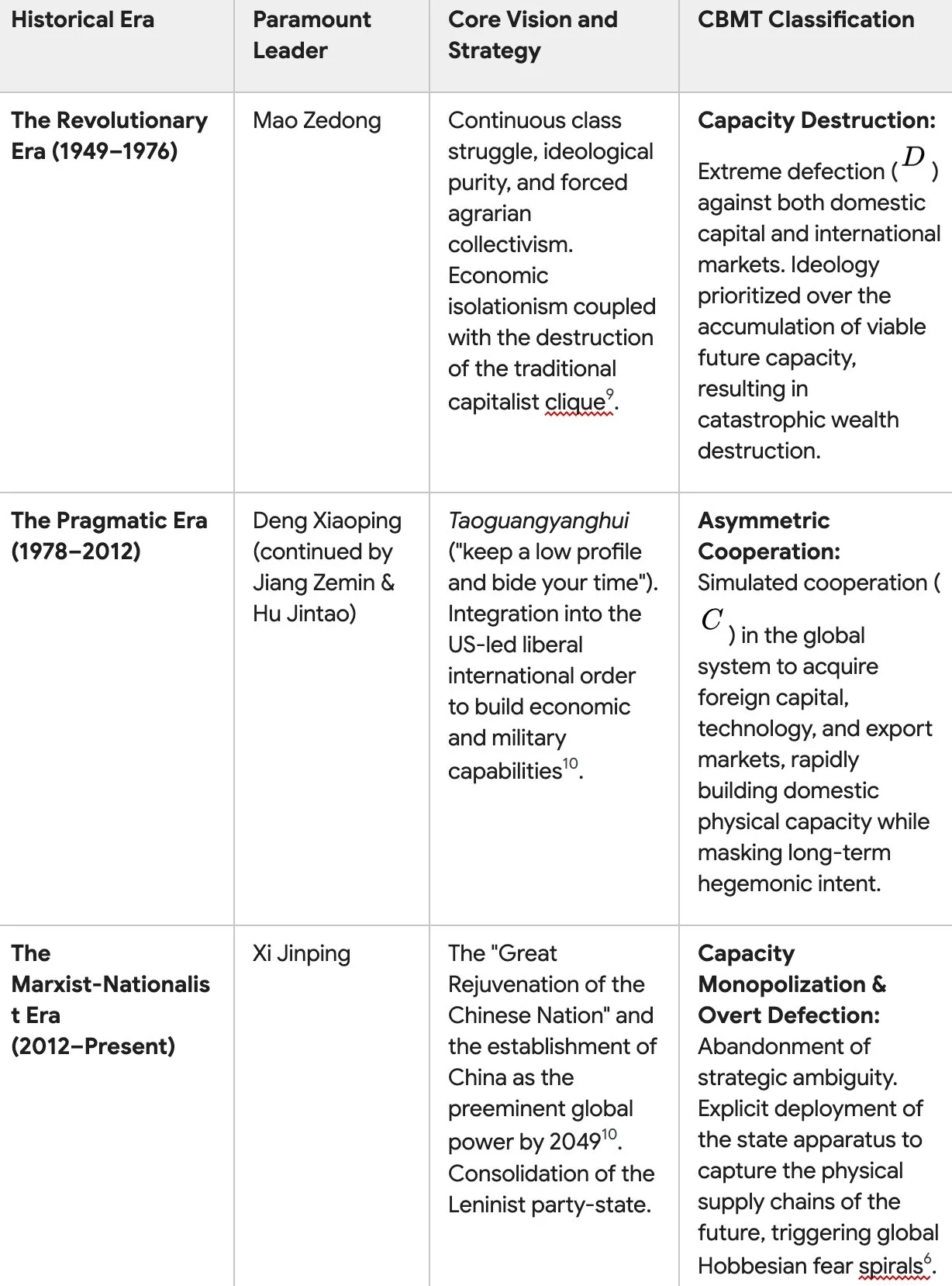
The Deng Xiaoping Consensus: Asymmetric Capacity Accumulation
Following the devastating capacity destruction of the Maoist era, Deng Xiaoping fundamentally rewrote the CCP's operational code. Deng recognized that China could never achieve great power status without first building an immense base of physical and technological capacity. His foreign policy strategy, taoguangyanghui, mandated that China must avoid conflict, accept a temporary American hegemony, and quietly accumulate power.
Through the lens of CBMT, Deng executed a brilliant strategy of asymmetric cooperation. By integrating into the World Trade Organization and presenting China as a cooperative partner in global supply chains, Deng suppressed the international Hobbesian Trap. Western nations, operating under neoclassical models that prioritized cheap consumer goods and short-term corporate profits, eagerly outsourced their physical manufacturing capacity to China. The implicit social contract forged during the Deng, Jiang, and Hu eras was strictly developmental: the CCP guaranteed rapidly rising living standards, urbanization, and personal wealth accumulation in exchange for unquestioned political obedience to the Party.
The Marxist-Nationalist Vision of Xi Jinping
Kevin Rudd's analysis outlines a stark, deliberate departure from the Deng consensus under Xi Jinping. Xi views the global arena not as a collaborative marketplace, but through the lens of historical determinism, Marxist economic theory, and deep-seated Han nationalism. His vision is explicitly articulated through the "Two Centennial Goals," culminating in the transformation of China into a "fully developed, rich, and powerful" nation by 2049, the 100th anniversary of the founding of the People's Republic. Furthermore, Xi has prescribed a view of history wherein the world is most stable when China is the preeminent, technologically advanced, and civilized power—a status he intends to reclaim on China's own terms.
Rudd's analysis highlights that Xi's China has evolved into a rigid Leninist party-state that has pivoted aggressively toward absolute central control. Xi does not optimize for consumer prosperity, the expansion of the middle class, or short-term GDP growth. Instead, his organizing principle is the construction of the world's most powerful, self-sufficient industrial state. To Xi, private entrepreneurs, consumer markets, and domestic capital allocators are merely tools subordinate to the strategic, capacity-building imperatives of the state.
This Marxist-Nationalist vision incorporates several critical operational directives designed to capture global capacity: The primary objective is to dominate the absolute foundation of the future economy, specifically advanced batteries, critical mineral refinement, renewable energy infrastructure, and the entire artificial intelligence technology stack, from physical chips to cloud infrastructure. To achieve this, the state engages in predatory subsidization. Capital is directed to subsidize industrial production far below the marginal cost of production until foreign competitors face insolvency and fold. Once global capacity is successfully captured and foreign alternatives are destroyed, monopolistic rents can theoretically be extracted. Concurrently, the deployment of absolute surveillance—including facial recognition, spatial tracking, and digital payments—acts as a dual-purpose mechanism of both internal political stability and massive data extraction to feed the AI infrastructure.
Modeling Xi's Vision Within the CBMT Framework
When Xi Jinping's strategy is subjected to the rigorous Capacity-Based Monetary Theory framework, it becomes evident that Beijing is attempting a highly sophisticated, state-level optimization of the Prisoner's Dilemma of Future Value.
Resolving the Domestic Prisoner's Dilemma via Coercion
In a purely free-market, neoclassical system, the rational impulse of individual actors is to defect toward short-term rent-seeking behaviors. This typically manifests as real estate speculation, financial engineering, or the creation of asset-light software monopolies, resulting in the atrophy of capital-intensive physical industrial capacity—a phenomenon widely observed in the deindustrialization of the West.
Xi Jinping utilizes the formidable apparatus of the Leninist party-state as the ultimate enforcer to artificially alter the payoff matrix of the domestic Chinese market. By systematically dismantling the power of consumer technology monopolies, heavily regulating the private tutoring sector, and actively deflating the heavily leveraged real estate bubble, the CCP has forcibly eliminated the highly profitable Defect ($D$) options for domestic capital. Capital, engineering talent, and labor are instead coerced into the Cooperate ($C$) strategy: investing in deep technology, advanced manufacturing, and strategic infrastructure.
Through the ontological lens of CBMT, Xi has accurately diagnosed that true superpower status is not derived from the accumulation of foreign exchange reserves or the market capitalization of consumer internet companies, but from the physical capacity to manufacture the future.
The Strategic Advantages of the Vision
Applying the CBMT framework allows for an objective assessment of the structural advantages embedded within the Xi Jinping doctrine. Unlike Western democracies, which are heavily constrained by the quarterly profit demands of financial markets and the vicissitudes of brief electoral cycles, the CCP operates on multi-decade horizons. This temporal advantage aligns perfectly with the optimal long-term capacity generation mandated by CBMT.
Furthermore, the ability to orchestrate the entire macro-economy and industrial base—synchronizing raw material extraction, refining, battery production, and vehicle assembly—creates immense economies of scale and network effects that fragmented, purely free markets struggle to match. By viewing the economy through an ontological lens rather than a purely financial one, China builds resilience against abstract financial shocks. As long as the factories, energy grids, and supply chains remain physically intact and operational, the state maintains true economic power, regardless of fluctuations in domestic or international equity markets.
Material Deviations from CBMT Predictions
While Xi's Marxist-Nationalist vision appears theoretically robust when mapped onto the goals of capacity hoarding, an exhaustive application of CBMT reveals profound material deviations and structural vulnerabilities in the execution of this model. China is currently experiencing systemic friction that indicates the model is not functioning optimally.
The Premature Activation of the Global Hobbesian Trap
Perhaps the most critical deviation from optimal game-theoretic strategy is China's premature activation of the international Hobbesian Trap. Deng Xiaoping's strategic genius lay in maintaining a cooperative facade in the global arena, delaying the geopolitical fear spiral for as long as possible.
Xi Jinping's explicit, public articulation of the "Chinese Dream," his stated deadlines for global preeminence by 2049, and his overt weaponization of supply chains signaled a definitive defection to the international community. As dictated by the mechanics of the Hobbesian Trap, this overt posture has triggered a rapid, reciprocal fear spiral. The United States and its allies have abruptly abandoned cooperative trade frameworks in favor of aggressive, defensive posturing. This includes enacting stringent export controls on advanced semiconductor manufacturing equipment, heavily subsidizing the reshoring of critical manufacturing, and implementing prohibitive tariffs on Chinese electric vehicles and green technology. By telegraphing his intent to capture global capacity before achieving absolute self-sufficiency, Xi provoked the very containment strategy that now threatens to throttle China's export-driven industrial machine.
The Ontological Destruction of Wealth: Stranded Assets
CBMT strictly distinguishes between productive capacity and sterile capacity. The most glaring deviation in China's economic model is the catastrophic misallocation of resources into non-productive infrastructure and real estate. Driven by the political directive to maintain artificial GDP growth targets over the past two decades, local governments and property developers amassed vast physical capacity in the form of unoccupied housing and redundant civic infrastructure.
In structural economics, these are defined as "stranded assets"—investments that have suffered premature devaluation due to shifts in societal demand or technological progress. CBMT penalizes the creation of stranded assets because they consume massive amounts of raw materials, labor, and energy without yielding any future productive value. The sheer scale of China's real estate overhang represents a massive destruction of ontological wealth, directly contradicting the CBMT goal of optimizing future productive power. The capital sunk into empty concrete towers cannot be easily rotated into semiconductor fabrication or advanced robotics.
The Paradox of Centralized Innovation
A further inherent flaw in Xi's vision is the paradox of centralized innovation. CBMT requires that future capacity be fundamentally viable, pushing the frontier of technological relevance. While authoritarian coercion can successfully force capital into scaling existing technologies (like solar panels and batteries), it struggles to mandate disruptive, zero-to-one innovation.
Empirical analysis of scientific output indicates that early-career researchers drive the most disruptive science, while rigid, hierarchical systems suffer from a "nostalgia effect" that stifles true innovation, as older scientists cling to past paradigms. Xi's insistence on absolute ideological conformity, the pervasive surveillance state, and the prioritization of the Party's interests above all else creates an environment deeply hostile to the localized, organic risk-taking required for the next generation of technological leaps. By demanding total political loyalty, the state inadvertently suppresses the intellectual capacity required to sustain the physical capacity it seeks to build.
The Fraying of the Social Contract: Real Estate and Youth Disillusionment
The transition from the pragmatic era of Deng to the ideological era of Xi has fundamentally ruptured the Chinese social contract. For forty years, the CCP's legitimacy rested on a simple, unspoken agreement: the state provides unprecedented economic growth and personal enrichment, and the citizens relinquish political rights. The physical manifestation of this growth was the real estate market, which became the primary vehicle for household wealth accumulation.
Recent macroeconomic indicators illustrate a profound, engineered contraction in the foundation of this old social contract. According to the National Bureau of Statistics of China, the investment in real estate development experienced a severe, structural contraction in 2025.
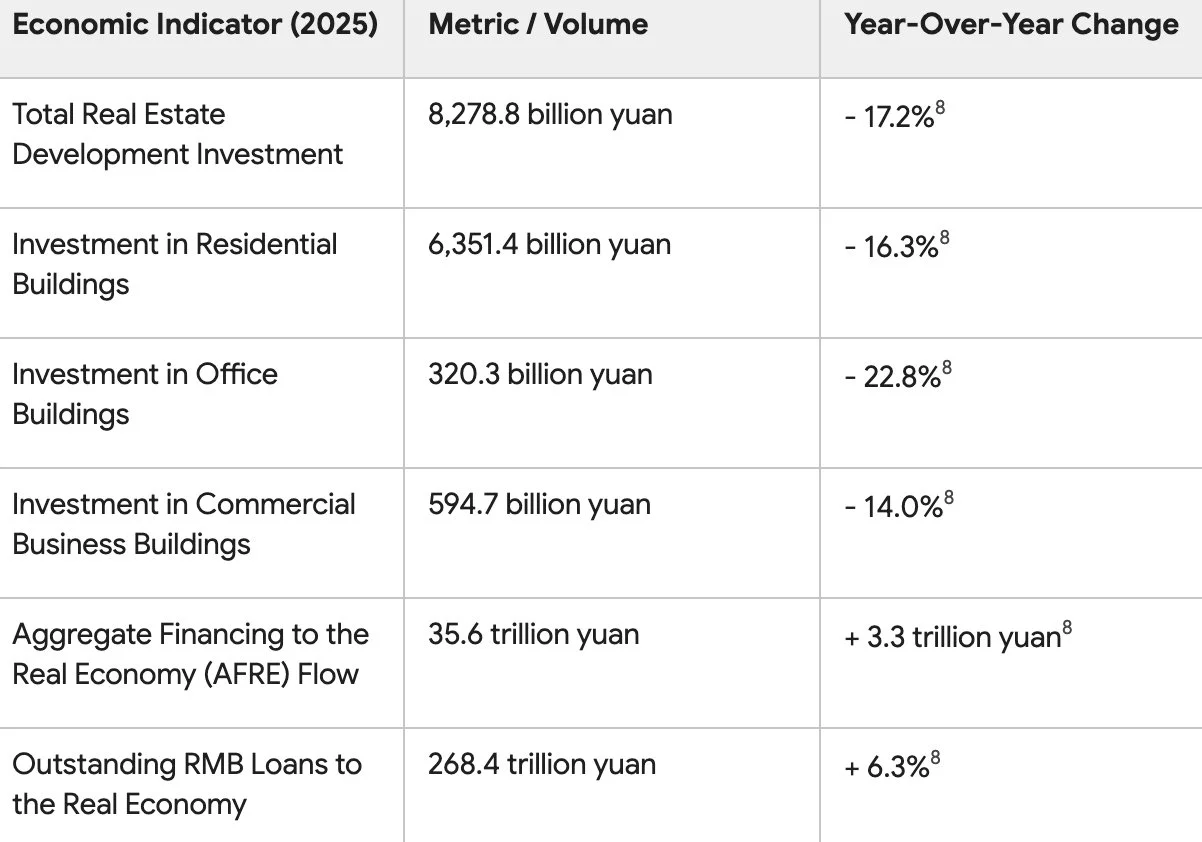
This data reveals a critical macroeconomic divergence: the state is aggressively pumping credit and liquidity into the "real economy"—defined by Xi as manufacturing, strategic infrastructure, and state-backed high-tech enterprises—while deliberately allowing the real estate sector to violently deflate.
Youth Unemployment and the Mandate to "Eat Bitterness"
The pivot from a real estate and consumer-services-led economy to a hard-tech, industrial juggernaut has severely disrupted the labor market, particularly for educated youth. The service sectors that typically absorb university graduates, such as consumer technology platforms, private tutoring, and finance, have been heavily regulated or outright suppressed in favor of advanced manufacturing and engineering.
In response to the resulting surge in youth unemployment and diminished economic prospects, Xi Jinping has not offered Western-style stimulus checks or a bolstered social safety net. Instead, he has deployed the rhetoric of Marxist Nationalism, bluntly instructing the younger generation to chi ku—to "eat bitterness".
This represents a perilous evolution of the social contract. The CCP is now demanding ideological devotion, nationalistic fervor, and immense personal sacrifice without the reciprocal guarantee of upward economic mobility. While nationalism remains a potent force in China—fueled by historical grievances regarding a "century of humiliation" and genuine pride in China's recent technological ascent—the endurance of the populace is finite. The massive, nationwide protests against the zero-COVID lockdowns in late 2022 served as a stark warning. Citizens explicitly demanded "food, not nucleic acid tests" and "dignity, not lies," demonstrating that there are hard limits to how much bitterness the population is willing to consume in the name of the state's geopolitical goals.
Strategic Interventions: Improving the Marxist-Nationalist Vision
To secure the long-term sustainability of the Chinese state, the current Marxist-Nationalist vision must evolve to reconcile its internal economic contradictions and mitigate the global Hobbesian Trap it has triggered. Viewed through the analytical framework of CBMT, several structural improvements can be modeled.
Internalizing Capacity Consumption
The most glaring flaw in Xi's economic model is the massive disconnect between infinite, state-subsidized capacity generation and finite domestic demand. China must shift its focus from purely supply-side subsidization to demand-side empowerment. This requires the establishment of a robust social welfare system, comprehensive healthcare, and secure pension guarantees. By alleviating the severe precautionary savings motive of the Chinese household, the state can unlock massive domestic consumption.
Under CBMT, this does not represent a retreat from capacity building, but rather a necessary completion of the economic circuit. If Chinese consumers are empowered to purchase the outputs of Chinese industrial capacity—such as electric vehicles, green energy infrastructure, and domestic semiconductors—the state radically reduces its vulnerability to Western tariffs and export controls, effectively insulating its capacity base from foreign geopolitical coercion.
De-escalating the Hobbesian Fear Spiral
Xi Jinping's aggressive diplomatic posture and overt declarations of global supremacy have proven strategically counterproductive. To stabilize the international environment and preserve access to global markets, Beijing must re-introduce a degree of strategic ambiguity. While China may continue to build its internal capacity, it must actively manage the perception of its external intentions.
By returning to a modified, modern iteration of Deng's taoguangyanghui, China can ease the bilateral fear driving the international Hobbesian Trap. This involves identifying and acting upon areas of genuine mutual cooperation with the West, thereby reducing the immediate, rational incentive for Western powers to preemptively defect through total economic decoupling.
Repurposing Stranded Assets
To address the ongoing real estate crisis, the state must aggressively accept the reality of its stranded assets. Rather than allowing abandoned residential blocks and commercial real estate to fester as dead capital, the state should utilize its centralized power to execute structural transitions. Obsolete commercial office towers and unfinished residential complexes must be rapidly repurposed into data centers, urban vertical farms, or highly subsidized public housing. This converts a negative draw on macroeconomic sentiment back into a functional, albeit altered, component of national productive capacity.
Conclusion
The strategic vision of China under Xi Jinping represents a grand, historically unprecedented experiment in macroeconomic statecraft. By utilizing the formidable machinery of a Leninist party-state to enforce the dictates of Marxist Nationalism, Xi is attempting to bypass the short-term financialization and rent-seeking behaviors that currently plague Western neoclassical economies. Viewed strictly through the lens of Capacity-Based Monetary Theory, Xi is executing a highly rational, ruthless strategy to capture the true ontological foundation of global wealth: the physical supply chains of the future.
However, this model exhibits severe material deviations from theoretical perfection. The deliberate suppression of domestic consumption, the catastrophic misallocation of capital into stranded real estate assets, and the premature triggering of a global Hobbesian fear spiral threaten to undermine the entire geopolitical project. Domestically, the social contract has been stretched taut, shifting abruptly from the promise of shared prosperity to the demand for national sacrifice and the "eating of bitterness" amid rising youth unemployment.
If Xi Jinping's China is to achieve its stated goal of great national rejuvenation by 2049, it must recognize that absolute authoritarian control is subject to the law of diminishing returns. The true test of the Marxist-Nationalist vision will not simply be its ability to forge steel, manufacture legacy semiconductors, or silence dissent, but its capacity to adapt to the complex, non-linear realities of both human nature and global macroeconomic equilibrium.
-
The Ezra Klein Show - Apple Podcasts, https://podcasts.apple.com/mx/podcast/the-ezra-klein-show/id1548604447?l=en-GB
What Xi Jinping Wants - The Ezra Klein Show - Apple Podcasts, https://podcasts.apple.com/us/podcast/what-xi-jinping-wants/id1548604447?i=1000776737823
Cyber Nationalism and Regime Support under Xi Jinping: The Effects of the 2018 Constitutional Revision - ResearchGate, https://www.researchgate.net/publication/346029744_Cyber_Nationalism_and_Regime_Support_under_Xi_Jinping_The_Effects_of_the_2018_Constitutional_Revision
Beijing's Leninist-Nationalist – Samuel Gregg - Law & Liberty, https://lawliberty.org/book-review/beijings-leninist-nationalist/
Why the Ram shortage is unlikely to change... : r/LinusTechTips - Reddit, https://www.reddit.com/r/LinusTechTips/comments/1rf4zvr/why_the_ram_shortage_is_unlikely_to_change/
May the Best System Win: What Kevin Rudd Can Teach Communities About Open-Source AI — Including China's, https://occupyai.net/may-the-best-system-win-what-kevin-rudd-can-teach-communities-about-open-source-ai-including-chinas/
Capacity-Based Monetary Theory and Game Theory: Resolving the Prisoner's Dilemma of Future Value : r/Economics - Reddit, https://www.reddit.com/r/Economics/comments/1rk6me0/capacitybased_monetary_theory_and_game_theory/
STATISTICAL COMMUNIQUÉ OF THE PEOPLE'S REPUBLIC OF CHINA ON THE 2025 NATIONAL ECONOMIC AND SOCIAL DEVELOPMENT, https://www.stats.gov.cn/english/PressRelease/202602/t20260228_1962661.html
Book review: Kevin Rudd, The Avoidable War: The Dangers of a Catastrophic Conflict between the US and Xi Jinping's China - R Discovery, https://discovery.researcher.life/article/book-review-kevin-rudd-the-avoidable-war-the-dangers-of-a-catastrophic-conflict-between-the-us-and-xi-jinping-s-china/fd93e845639d37be923d47efb68b7746
Return of the Dragon: Xi Jinping's Nationalist Vision & Global Ambitions, https://www.cjfp.org/return-of-the-dragon-xi-jinpings-nationalist-vision-global-ambitions/
What Xi Jinping Wants | The Belfer Center for Science and International Affairs, https://www.belfercenter.org/publication/what-xi-jinping-wants
HSF 2025: Are We Living in a Chinese Century? (Transcript) - The Singju Post, https://singjupost.com/hsf-2025-are-we-living-in-a-chinese-century-transcript/
The Stranded Asset Real Estate Crisis : r/fican - Reddit, https://www.reddit.com/r/fican/comments/1tlhmld/the_stranded_asset_real_estate_crisis/
China 2022: The 20th party congress and popular discontent in Xi Jinping's China - Asia Maior - An Italian think tank on Asia, https://www.asiamaior.org/the-journal/17-asia-maior-vol-xxxiii-2022/china-2022-the-20th-party-congress-and-popular-discontent-in-xi-jinpings-china.html