


Capacity-Based Analysis of the San Francisco Bay Area Legal and Institutional Environment
Introduction to the Crisis of Municipal Capacity
The San Francisco Bay Area represents one of the most concentrated agglomerations of human capital, technological efficiency, and aggregate wealth in modern economic history. Historically, the region has functioned as the preeminent engine of global innovation, commanding massive agglomeration premiums and driving extraordinary economic output. However, beneath the surface of this economic powerhouse lies a profound and accelerating structural degradation of its legal, political, and institutional environment. To rigorously understand the root causes, mechanical failures, and staggering economic costs of this degradation, it is necessary to move beyond the boundaries of standard neoclassical economic analysis and employ Capacity-Based Monetary Theory (CBMT).
Under the CBMT framework, money and municipal value are not static stores of wealth, nor are they mere fiat illusions. Rather, they are floating-price claims on the future productive capacity of an economy. This productive capacity is determined by a dynamic vector function of aggregate labor, the efficiency of that labor as amplified by technology and human capital, and, crucially, the stability of the institutional social contract that allows this labor to project value into the future. When an individual, corporation, or investor accepts the currency or buys into the real estate of a municipality, they are essentially acquiring a call option on the future labor and institutional stability of that society.
When the institutional frameworks of a municipality begin to fray—due to political capture, excessive bureaucratic friction, ideological rigidity, or the breakdown of fundamental public safety—the frictional costs of trust and order skyrocket. In the Bay Area, and San Francisco in particular, the local government has increasingly failed to maintain the institutional "Leviathan" required to suppress transaction costs and enforce the social contract. Consequently, the city is experiencing a localized reversion toward a Hobbesian state, characterized by unpredictable regulatory enforcement, unchecked property crime, and entrenched political machines that extract massive deadweight losses from the productive economy.
This comprehensive research report provides an exhaustive, data-driven analysis of the weaknesses embedded within the current legal and political environment of the Bay Area. Utilizing insights from prominent technology leaders and political organizers such as Garry Tan, alongside municipal budget data, economic cost modeling, and institutional jurisprudence, this analysis diagnoses the specific structural failures of the region. Furthermore, this report models the multi-billion-dollar costs these issues impose on the Bay Area and outlines actionable, voter-friendly methods for addressing them through charter reform, regulatory streamlining, and pragmatic political realignment.
Actionable, Voter-Friendly Remediation Strategies
To reverse the degradation of the Institutional Realization Rate ($I$) and restore the Bay Area's expected future impact, a comprehensive, structural overhaul of the legal and political environment is required. Marginal policy tweaks are insufficient; the solutions must bypass the entrenched political machine by appealing directly to the voters through direct democracy and systemic reform.
Civic organizations like GrowSF, TogetherSF, and Garry Tan's network have pioneered the concept of building "parallel machines" to educate, organize, and mobilize the electorate toward pragmatic, centrist reforms. The following are actionable, voter-friendly methods to address the identified weaknesses, categorized by their institutional target.
1. Building the Parallel Civic Machine
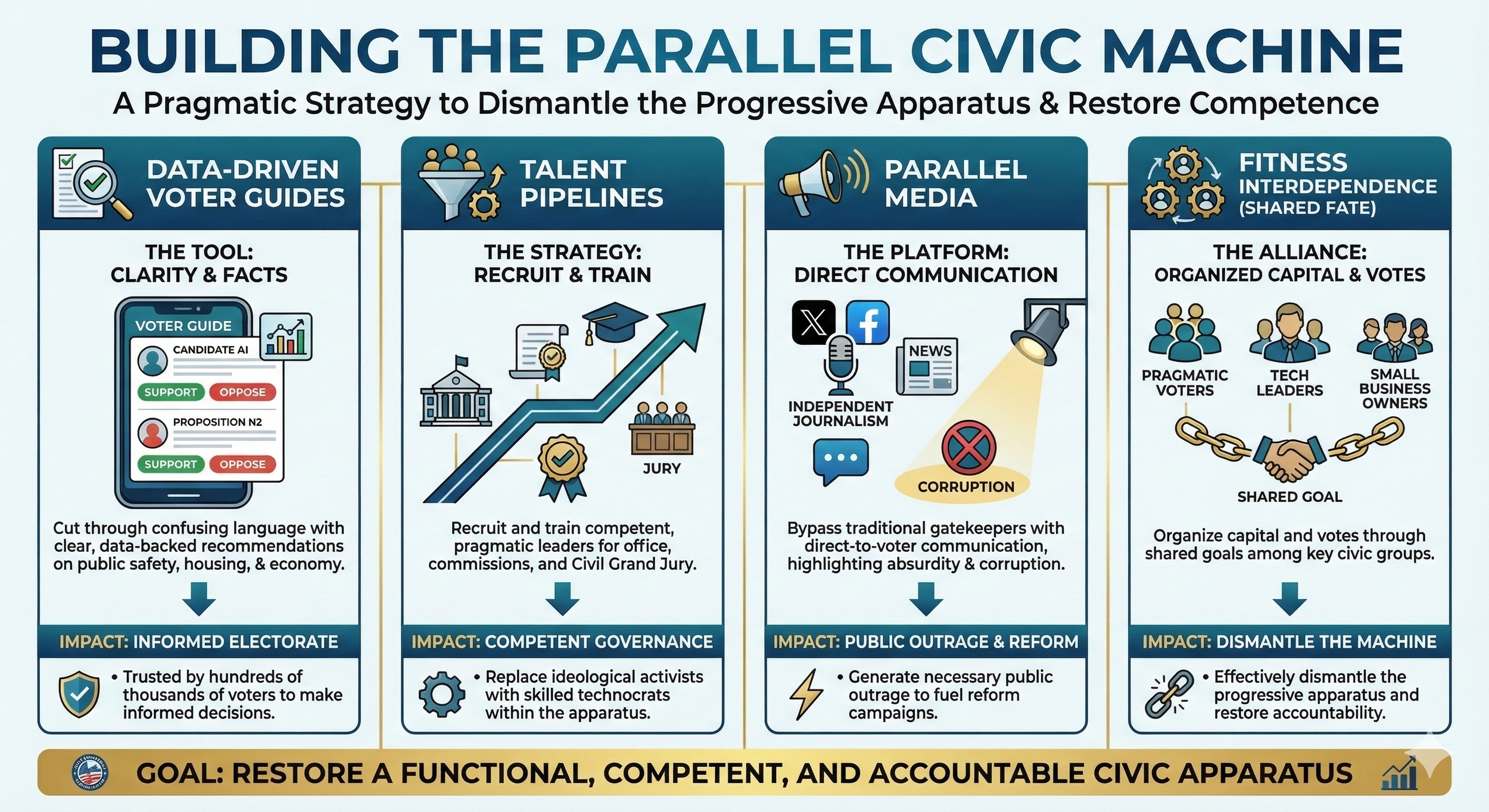
As Garry Tan has articulated, the traditional unelected political machine relies on a monopoly of information, institutional inertia, and the funding of parallel progressive nonprofits. To defeat it, pragmatic centrists must build and fund their own infrastructure.
Data-Driven Voter Guides: Organizations like GrowSF distribute highly effective, data-backed voter guides that cut through deliberately confusing ballot language. These guides clearly outline which candidates and propositions support public safety, housing growth, and economic pragmatism, and are trusted by hundreds of thousands of voters.
Talent Pipelines: To permanently alter the bureaucracy, groups are recruiting and training a new generation of pragmatic leaders to run for office, serve on city commissions, or join the Civil Grand Jury. This ensures that competent technocrats replace ideological activists within the apparatus.
Parallel Media: Utilizing platforms like X (formerly Twitter) and funding independent local journalism to bypass the traditional political communications apparatus. This direct-to-voter communication highlights the absurdities, grifts, and corruption of the incumbent machine, generating the public outrage necessary to fuel reform campaigns.
By establishing "Fitness Interdependence" (Shared Fate) among pragmatic voters, tech leaders, and small business owners, this parallel machine can organize capital and votes effectively enough to dismantle the progressive apparatus.
2. Comprehensive Charter Reform and Executive Restoration
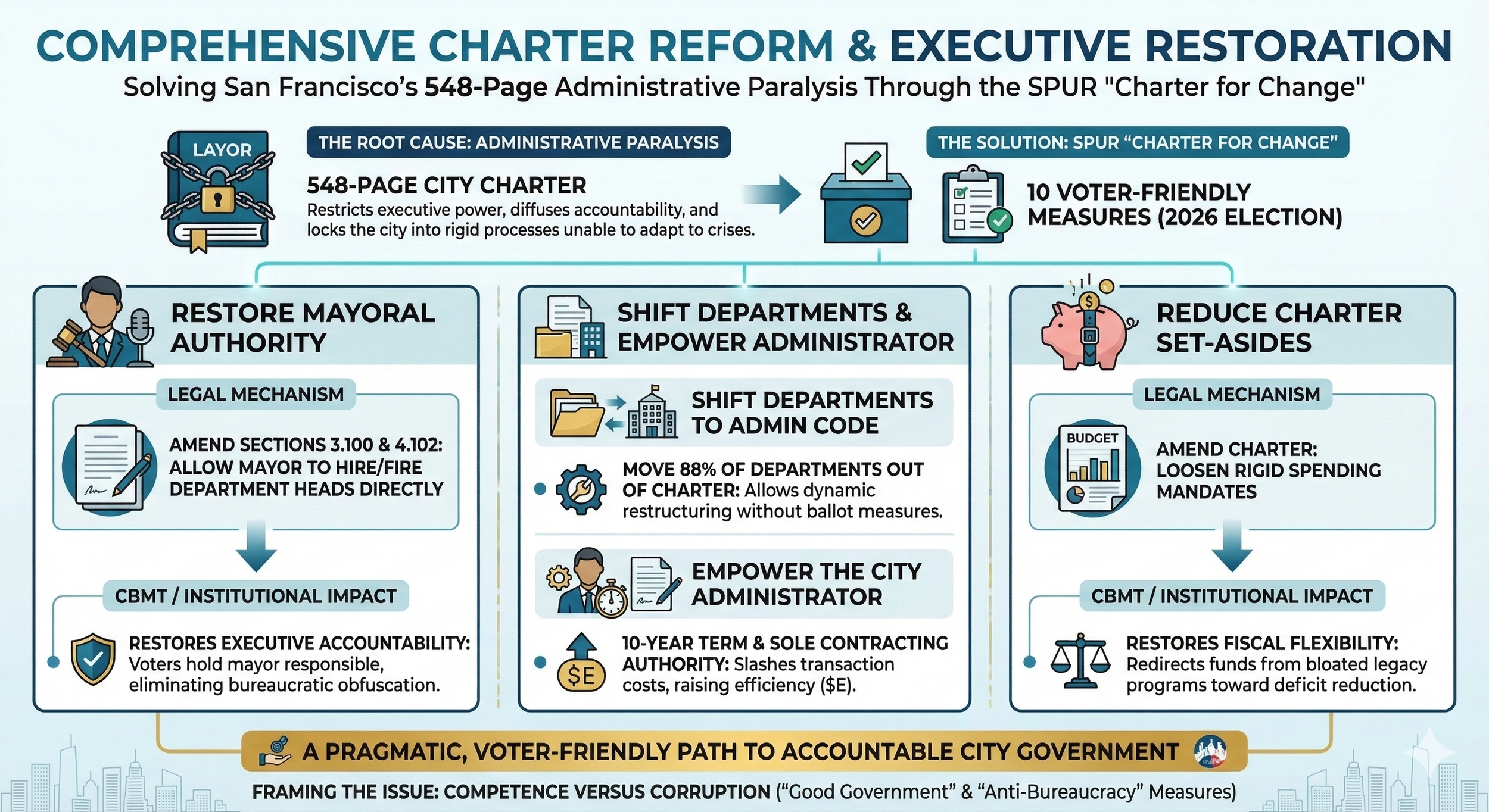
San Francisco's 548-page city charter is the root cause of its administrative paralysis. It restricts executive power, diffuses accountability, and locks the city into administrative processes that cannot adapt to crises. SPUR (San Francisco Bay Area Planning and Urban Research Association) has outlined a comprehensive "Charter for Change" featuring 10 specific, voter-friendly ballot measures intended for the 2026 election.
The most critical charter reforms required to restore institutional efficiency include:
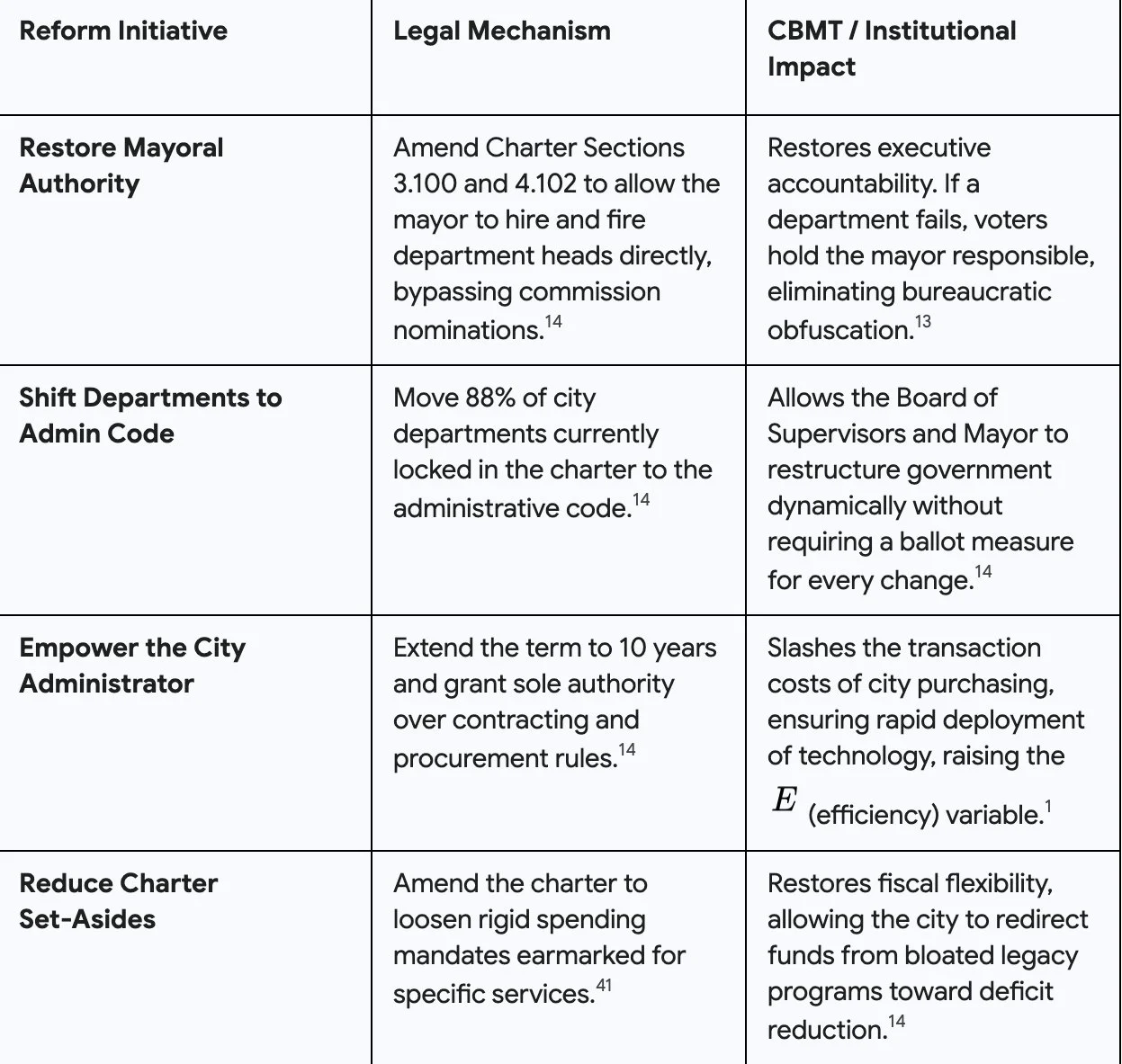
By presenting these reforms to the electorate as "Good Government" and "Anti-Bureaucracy" measures, they possess strong voter appeal across ideological lines, framing the issue as competence versus corruption.
3. Commission Streamlining and Bureaucratic Reduction
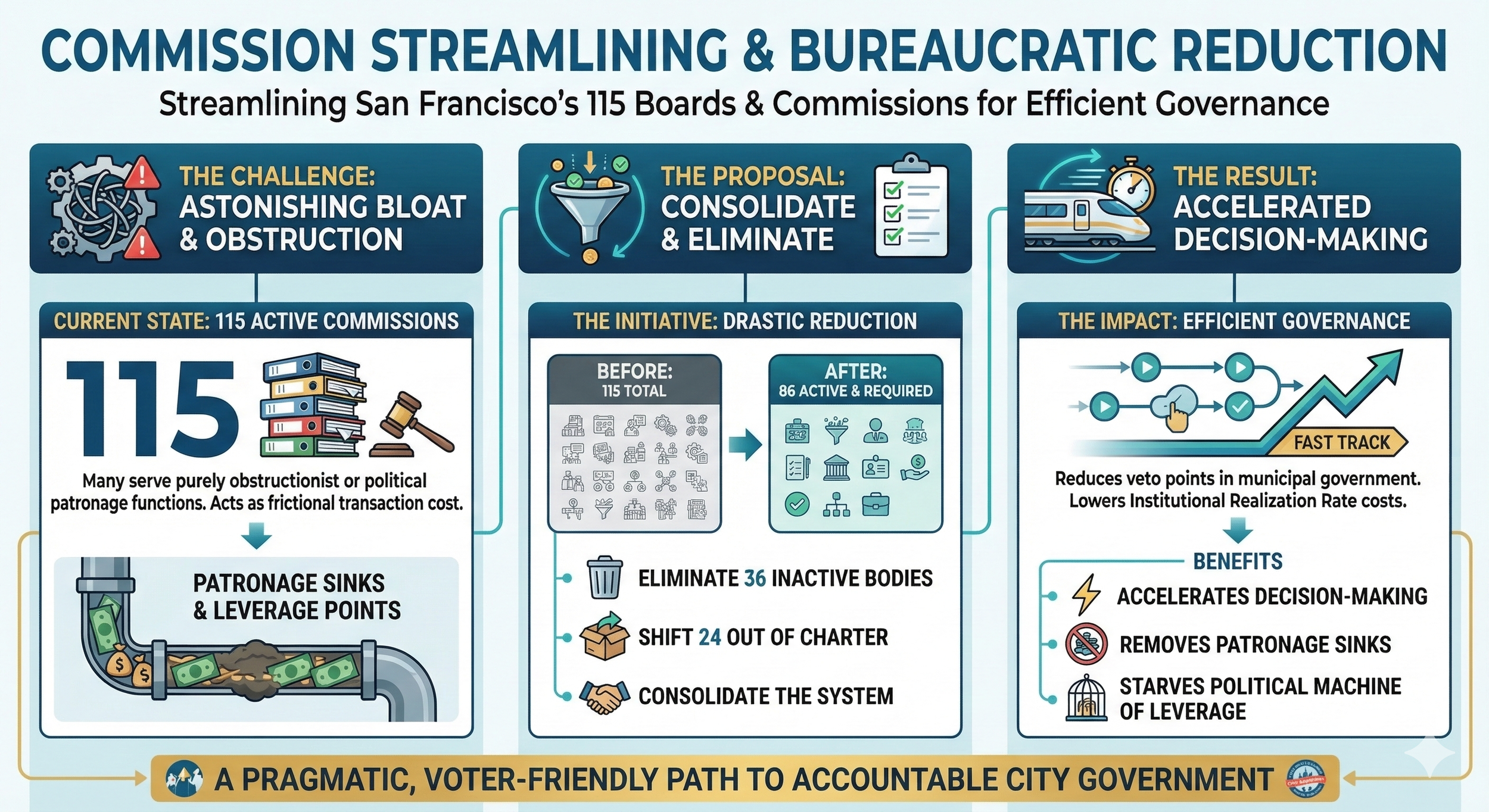
San Francisco currently maintains an astonishing 115 active boards and commissions, many of which serve purely obstructionist or political patronage functions. A highly actionable, voter-friendly initiative currently underway via a working group aims to drastically reduce this number to streamline governance.
The proposal consolidates the system down to 86 active and legally required bodies, explicitly eliminating 36 inactive bodies, and shifting 24 out of the charter entirely. Streamlining these commissions reduces the number of veto points in the municipal government. In CBMT terms, every unnecessary commission acts as a frictional transaction cost that lowers the Institutional Realization Rate. By dismantling the bloated commission structure, the city accelerates decision-making, removes patronage sinks, and starves the unelected political machine of its leverage points.
4. Housing Entitlement By-Right and the End of Discretionary Review
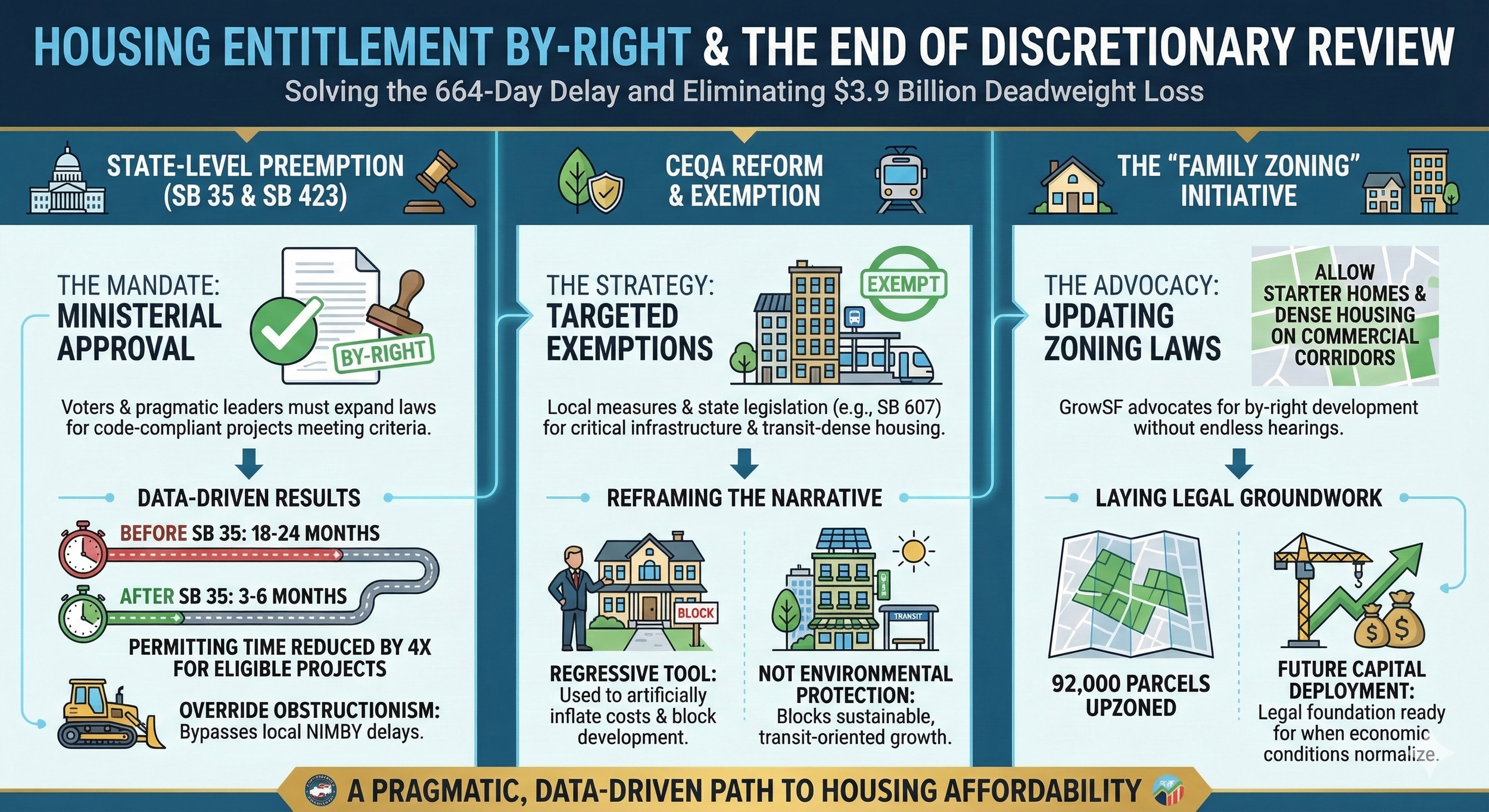
To solve the 664-day permitting delay and eliminate the $3.9 billion deadweight loss in housing construction, the legal environment must be fundamentally altered to eliminate discretionary review for code-compliant projects.
State-Level Preemption (SB 35 and SB 423): Voters and pragmatic leaders must continue to lean on, fund advocacy for, and expand state laws like SB 35 and SB 423, which mandate ministerial (by-right) approval for housing projects that meet certain affordability and labor criteria. Data conclusively shows that SB 35 has already reduced housing permitting times in San Francisco by four times (from 18-24 months down to 3-6 months) for eligible projects. Expanding these state-level preemptions overrides local NIMBY obstructionism.
CEQA Reform and Exemption: While full repeal of the California Environmental Quality Act is politically difficult at the state level, local ballot measures and targeted state legislation (like SB 607) can exempt critical infrastructure and dense housing near transit from environmental review. The political narrative must frame CEQA not as an environmental protection law, but as a regressive tool used by wealthy homeowners to artificially inflate housing costs and block sustainable, transit-oriented development.
The "Family Zoning" Initiative: Local groups like GrowSF advocate heavily for "Family Zoning," which updates zoning laws to allow families to build starter homes or dense housing on commercial corridors without facing endless hearings. While the current implementation of this upzoning plan faces macroeconomic headwinds due to high construction costs and market weakness , legally enshrining the upzoning of 92,000 parcels lays the necessary legal groundwork for massive capital deployment when interest rates and material costs normalize.
5. Restoring the Leviathan: Public Safety and Technological Leverage
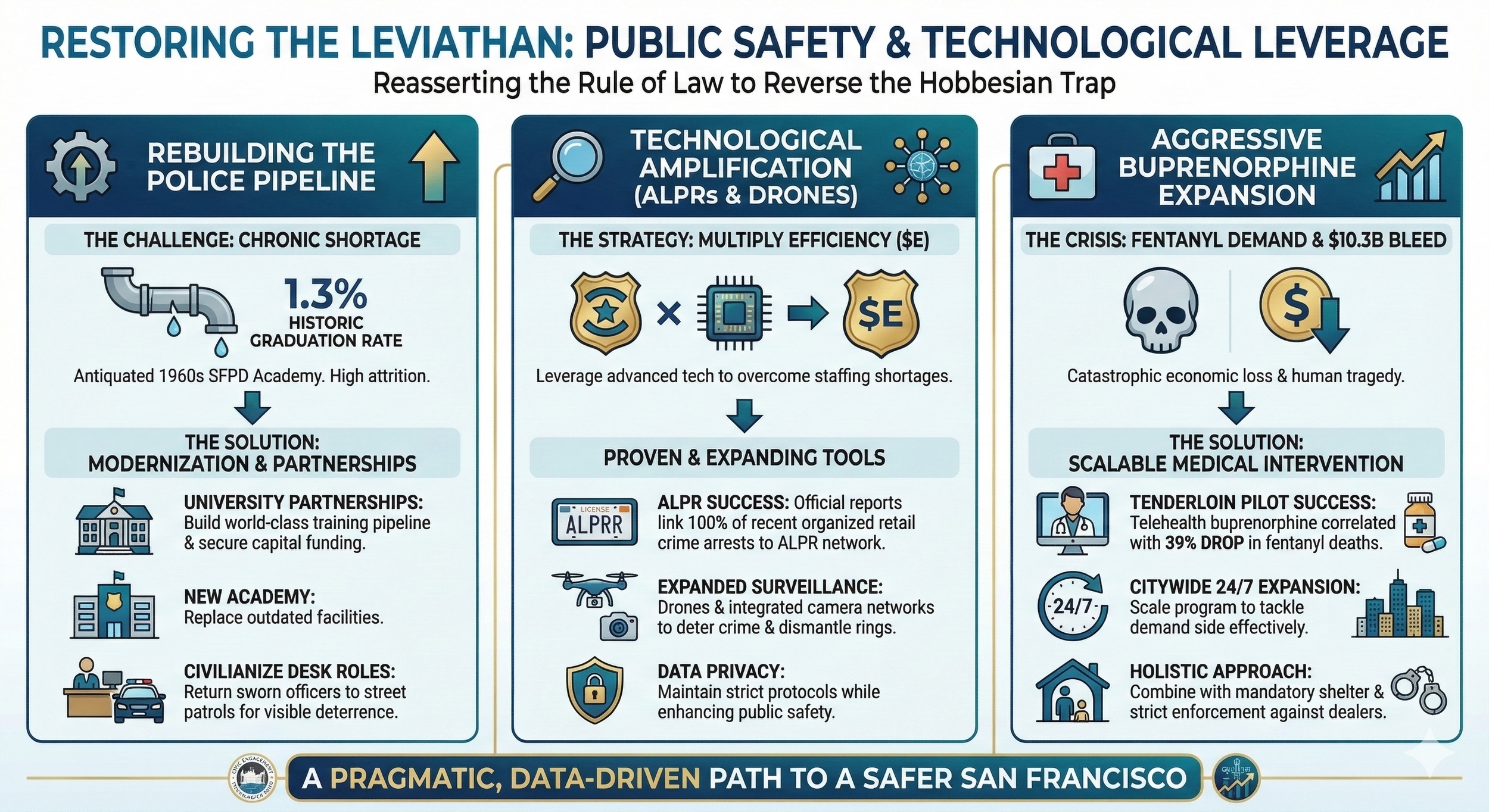
To reverse the Hobbesian Trap of organized retail theft and open-air drug markets, the city must aggressively reassert its monopoly on force and the rule of law.
Rebuilding the Police Pipeline: San Francisco suffers from a chronic, severe police shortage, with graduation rates for applicants historically hovering at a dismal 1.3%. Voter-friendly initiatives must bypass the political machine by partnering directly with local universities to build a world-class training pipeline and secure capital funding to replace the antiquated 1960s SFPD Academy. Furthermore, aggressively civilianizing desk roles will immediately return sworn officers to street patrols, increasing visible deterrence.
Technological Amplification (ALPRs and Drones): Given the severe staffing shortages, the city must multiply the efficiency ($E$) of its existing police force using advanced technology. The recent deployment of Automated License Plate Readers (ALPRs) has already proven highly effective; official reports indicate that all organized retail crime arrests in San Francisco in recent quarters were directly attributed to the ALPR network. Expanding algorithmic policing, drone surveillance, and integrated camera networks—while maintaining strict data privacy protocols—is a highly cost-effective, voter-friendly method of deterring crime and dismantling theft rings.
Aggressive Buprenorphine Expansion: To tackle the demand side of the fentanyl crisis and reduce the catastrophic $10.3 billion economic bleed, the city must expand medical interventions that work. The recent nighttime pilot program that connects people in the Tenderloin with a doctor via telehealth to prescribe buprenorphine (a medication for opioid use disorder) on the spot has shown massive success, correlating with a 39% drop in fentanyl deaths since its launch. Scaling this program citywide, 24/7, combined with mandatory shelter and strict enforcement against dealers, is a highly pragmatic, data-driven solution to restore human capital.
Theoretical Framework: Capacity-Based Monetary Theory Applied to San Francisco
To accurately price the cost of the Bay Area's institutional failures and design effective remediation strategies, one must first establish a rigorous theoretical foundation. Capacity-Based Monetary Theory provides the exact diagnostic tools required to dissect the San Francisco crisis, integrating the augmented growth models of Mankiw, Romer, and Weil with the institutional frameworks of Douglass North and the allocation theories of Gary Becker.
The Production Function of Municipal Impact
In an economic sense, municipal impact is synonymous with real output ($Y$)—representing the tangible goods, services, and innovations that a city produces. The capacity to produce this impact relies on the Augmented Solow-Swan model (the Mankiw-Romer-Weil specification), which treats human capital ($H$) as an independent, accumulating factor of production alongside physical capital. The rigorous production function for impact is defined mathematically as:
$$Y = K^\alpha (E \cdot H \cdot L)^{1-\alpha}$$
Where $K$ represents the stock of physical capital (housing, infrastructure, commercial real estate), $E$ is efficiency capacity (technology and institutional structure), $H$ is human capital (skills, education, health of the workforce), and $L$ is the aggregate labor force. The Bay Area possesses globally unmatched levels of $H$, driven by a highly educated tech workforce, and $E$, driven by venture capital and technological innovation. Historically, this allowed the region to generate immense expected future impact, driving up property values, wages, and the region's overall economic premium. A strong municipal economy is essentially a bet on the society’s ability to maintain high levels of investment in both human capital and physical infrastructure.
The Institutional Realization Rate ($I$) and the Hobbesian Trap
However, theoretical capacity is meaningless if the fruits of labor cannot be secured due to a breakdown in the legal and institutional frameworks. Production capacity is purely theoretical if the local government cannot guarantee the passage of time required to redeem claims on value. To account for this, CBMT introduces the Institutional Realization Rate ($I$), a coefficient between 0 and 1, which represents the effectiveness of the rule of law, contract enforcement, and public safety.
The actual realized value of the municipal economy is therefore modeled as:
$$Realizable Impact = Y \times I$$
In a high-trust, well-governed society (such as Switzerland), the $I$ coefficient approaches 1, meaning the theoretical capacity of the population is fully realizable. In a failing institutional environment, $I$ drops significantly. When the local government fails to enforce basic laws—such as prosecuting retail theft, clearing open-air drug markets, or providing predictable timelines for building permits—it precipitates what CBMT refers to as a "Hobbesian Trap".
Thomas Hobbes described the state of nature as a condition of war where life is solitary, poor, nasty, brutish, and short. In economic terms, a Hobbesian state is a regime of infinite transaction costs. Money and long-term investment cannot exist in a Hobbesian state because they are inherently claims on the future; if the future is characterized by violence, expropriation, or infinite bureaucratic delay, the discount rate effectively becomes infinite. No rational economic agent will exchange capital today for a token promising a return tomorrow if "tomorrow" brings arbitrary confiscation or chaotic street conditions.
In the Bay Area, the decline of the Institutional Realization Rate is the primary driver of the current economic crisis. The $I$ coefficient is being artificially suppressed by an entrenched political machine that prioritizes ideological rigidity, bureaucratic veto points, and the extraction of rents via nonprofit networks over the fundamental maintenance of civic order.
O-Ring Filtering and the Hamilton Regime Shift
The specific dynamics of San Francisco's decline can be further explained by Michael Kremer’s O-Ring Theory of Economic Development, integrated into the CBMT framework. Kremer demonstrated that in complex production processes, high-skill workers cluster together because a single mistake by a low-skill component destroys the value of the entire chain. San Francisco historically functioned as the ultimate O-Ring filter. Its high cost of living acted as a screening mechanism, setting a cost of entry that guaranteed immense talent density and maximized the probability of serendipitous, high-value synergy.
However, this filter only functions if the high costs guarantee a high-efficiency network. When the physical environment becomes unsafe, unsanitary, or overly hostile to business, the agglomeration premium collapses. Elite workers and corporations, who are highly mobile, simply leave. To price this risk, CBMT employs the Hamilton Filter, a stochastic regime-switching model used to estimate discrete shifts in time series data. When the Hamilton Filter detects a shift in the transition matrix suggesting that the local "Leviathan" is losing control of its streets and institutions, the market updates the probability of a "Collapse Regime". The subsequent spike in the discount rate manifests as crashing commercial real estate values and capital flight.
The Degradation of the Legal and Political Environment
The degradation of the Bay Area's Institutional Realization Rate is not an accident of nature, macroeconomic headwinds, or localized bad luck. It is the direct result of specific, identifiable political and legal structures that have systematically captured the municipal apparatus. An exhaustive analysis of the local political environment reveals a system that has been subsumed by a coalition of public-sector unions, highly funded but unaccountable nonprofits, and ideologically driven progressive supervisors.
The Unelected Political Machine and Institutional Capture
Technology leaders and civic organizers, most notably Y Combinator CEO Garry Tan, have extensively documented the mechanics of this political machine. According to this critique, the traditional San Francisco political apparatus operates as an unelected shadow government, insulated from the voters it purportedly serves. This machine utilizes a vast network of city-funded nonprofits to administer core social services, particularly in the realms of homelessness, supportive housing, and drug rehabilitation.
Because these nonprofits are largely shielded from democratic accountability and rigorous, data-driven performance auditing, they create a perverse incentive structure. Solving the crises they are funded to address would effectively result in the loss of their lucrative city contracts. This dynamic is a textbook example of institutional capture, where the agents tasked with delivering a public service capture the regulatory and funding apparatus to ensure the continuous flow of capital without the obligation of delivering the desired outcome.
Tan, who has spent nearly half a million dollars of his own capital organizing centrist political action since 2015, has articulated that replacing this machine requires building a "parallel" civic infrastructure. He has frequently drawn the ire of the progressive establishment, famously quoting Tupac Shakur lyrics in a late-night social media post directed at progressive supervisors, which he later apologized for, stating it was intended as a political joke but was received as a threat. Despite the controversy, his underlying critique remains a cornerstone of the modern centrist movement in San Francisco: the city’s legal and political environment has been hijacked by idealists who refuse to acknowledge the nuts-and-bolts realities of civic governance.
Corruption, Patronage, and the "Chinatown Grift"
This institutional opacity frequently crosses the line from mere inefficiency into outright patronage and corruption. A specific manifestation of this institutional decay is the phenomenon colloquially referred to by reformers as the "Chinatown Grift," which involves networks of localized political fiefdoms, opaque property holdings, and the funneling of public funds.
Within San Francisco, organizations such as the Rose Pak Democratic Club and the Chinatown Community Development Center (CCDC) wield immense political influence over zoning approvals, real estate development, and the disbursement of city grants. The utilization of numerous opaque Limited Liability Companies (LLCs) to hold real estate, manage city grants, and obscure ownership creates a labyrinthine financial structure that shields operations from public and journalistic scrutiny. This allows connected insiders to extract rents from the city budget while blocking competitive development that might challenge their hegemony.
The systemic nature of this patronage was recently highlighted by the Collective Impact scandal. An investigation revealed that a city official directed public funds to projects and nonprofits with deep personal ties, most notably to Collective Impact, whose executive director was living with the official. The city attorney and the San Francisco district attorney were forced to launch separate investigations into the alleged fraud and misuse of funds, ultimately seeking to ban the nonprofit from receiving city grants for five years. When public funds are siphoned into patronage networks rather than being invested in human capital ($H$) or physical infrastructure ($K$), the efficiency capacity ($E$) of the municipality degrades, lowering the overall output of the city.
Charter Complexity as Legal Friction
The legal environment exacerbates this capture through structural complexity. The San Francisco City Charter, which serves as the local constitution, is an astonishingly bloated document spanning 548 pages. Over the past 30 years, it has been expanded by over 100 voter-approved amendments, transforming it from a foundational legal framework into a massive procedural manual that dictates minutiae and restricts executive agility.
This charter fragments executive power across 115 different boards and commissions. This extreme fragmentation diffuses accountability, making it nearly impossible for voters to identify who is actually responsible for systemic failures. For example, the mayor currently lacks the unilateral authority to hire or fire many department heads without the approval of these commissions. Consequently, the executive branch is rendered impotent, unable to enact rapid operational changes during crises, while the unelected political machine assumes de facto control through its influence over the commission appointees. In the context of CBMT, this charter complexity represents a massive frictional transaction cost that degrades the Institutional Realization Rate.
Ideological Rigidity and the Rejection of the Solow Residual
The political machine's legal environment is characterized by a fundamental, ideological rejection of economic growth. Through heavily restrictive zoning, the weaponization of environmental laws, and mandatory discretionary review processes, the city legally penalizes the creation of new physical capital ($K$).
Furthermore, the ideological commitment to policies that refuse to penalize property crime or open-air drug use directly attacks the region's human capital ($H$) and talent density. Elite labor relies on the aforementioned O-Ring dynamics; if the physical environment becomes unsafe or unsanitary, the cluster breaks down. Garry Tan and civic groups like GrowSF and TogetherSF have pointed out that policies prioritizing "harm reduction" to the absolute exclusion of law enforcement have functionally surrendered the city's public spaces to drug cartels and organized retail theft rings. This is not an accident, but a feature of an ideological framework that views enforcement as inherently oppressive, thereby willingly sacrificing the Hobbesian baseline of public safety.
Economic Cost Modeling of Institutional Failures
To fully grasp the severity of the Bay Area's legal and political weaknesses, we must translate these qualitative institutional failures into explicit, quantitative economic costs. By utilizing the CBMT framework, we can model how the degradation of the Institutional Realization Rate manifests in four primary domains: the housing permitting crisis, the retail theft epidemic, the fentanyl overdose crisis, and the resulting fiscal deficit.
1. The Housing Permitting Crisis: The Cost of Infinite Delay
San Francisco's housing entitlement process is widely considered the most complex, expensive, and unpredictable in the United States, representing a catastrophic failure to accumulate physical capital ($K$). The legal environment mandates that even fully code-compliant projects are subject to discretionary review, allowing single individuals or neighborhood groups to halt development indefinitely.
The primary weapon used in this obstruction is the California Environmental Quality Act (CEQA). Originally intended to protect natural habitats, CEQA has been entirely weaponized by neighborhood preservationists (NIMBYs), rival developers, and labor unions to extort concessions or block housing entirely. Because almost anyone can file a CEQA lawsuit anonymously and with minimal upfront cost, it introduces stochastic, unquantifiable risk into every real estate development pro forma. As noted by legal experts, a new building could conform to every San Francisco housing rule and receive City Hall approval, but still face years of delays from CEQA appeals.
The economic cost of this legal environment is staggering. According to recent data, the average time to get a housing permit approved in San Francisco is 664 days—nearly two years merely to secure the paperwork to begin construction. Furthermore, a comprehensive study by RAND indicates that multifamily housing in California costs more than twice as much per square foot to construct as it does in states like Texas or Colorado, largely due to these extended timelines, exorbitant impact fees, and strict design and labor requirements.
To quantify the explicit monetary cost of this regulatory burden, we look to adjacent markets. A rigorous economic study analyzing the premium paid for "ready-to-issue" (RTI) pre-approved permits in Los Angeles found that developers pay a 50% premium—equating to $48 per square foot—just to avoid the permitting process. This indicates that the legal friction itself constitutes exactly one-third of the gap between home prices and raw construction costs.
In San Francisco, the state housing mandate requires the city to permit and build 82,000 new homes by 2031. However, in 2024, the city built only 1,735 new homes, the lowest figure in a dozen years.
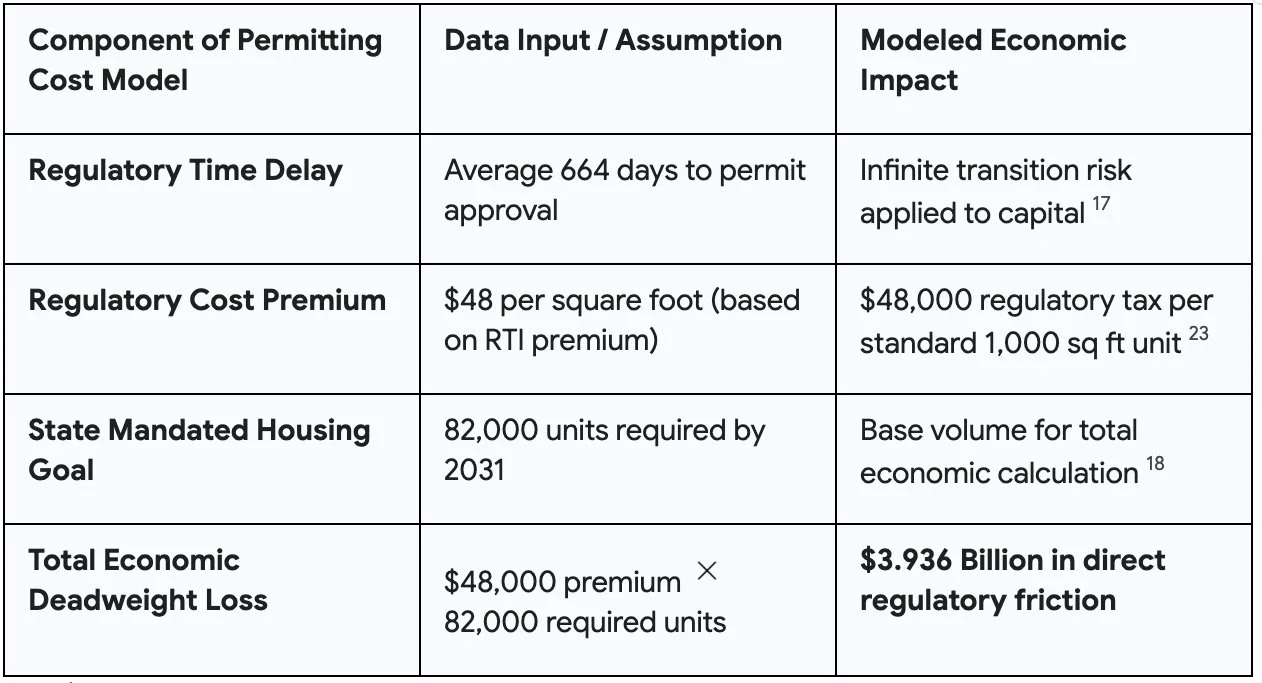
This \$3.9 billion figure represents only the direct, upfront deadweight loss imposed by the permitting system. It does not account for the secondary, macroeconomic effects of labor misallocation, where exorbitant housing costs prevent highly productive workers from moving to the region, thereby stifling the aggregate output ($Y$) of the entire Bay Area economy.
2. The Collapse of the Hobbesian Contract: Organized Retail Crime
The second major weakness in the legal environment is the failure of the municipal Leviathan to maintain a monopoly on force and protect private property, directly violating the Hobbesian mandate. Progressive criminal justice reforms (such as Proposition 47, which reclassified many nonviolent thefts as misdemeanors), combined with understaffed police departments and restrictive pursuit policies, have created a high-reward, low-risk environment for organized retail crime (ORC).
While some national data suggests overall violent crime is decreasing, California has experienced a unique and persistent surge in specific property crimes. Shoplifting in California increased by 13.8% in 2024 and is now 48% higher than pre-pandemic levels in 2019. The situation deteriorated to the point where the California Highway Patrol's (CHP) Organized Retail Crime Task Force was forced to step in where municipal authorities had failed. Between October 2023 and June 2025, state-funded local law enforcement operations resulted in a staggering 25,675 arrests and the recovery of \$190 million in stolen property across the state. In 2025 alone, the task force recovered \$8.6 million in stolen goods.
However, the value of recovered goods represents only a minuscule fraction of the total economic damage. The true cost of retail theft extends far beyond the direct inventory loss (shrink). It includes:
- Security Expenditures: The necessity of hiring private armed guards, installing reinforced glass, and locking everyday merchandise behind plexiglass degrades the consumer experience and dramatically reduces sales velocity.
- Business Closures: Major corporate retailers and vulnerable small businesses alike are forced to abandon high-theft corridors, leading to boarded-up storefronts, loss of neighborhood amenities, and spreading blight.
- Loss of Municipal Tax Revenue: When businesses close or relocate, the municipality permanently loses sales tax, payroll tax, and commercial property tax revenue, accelerating the city's fiscal death spiral.
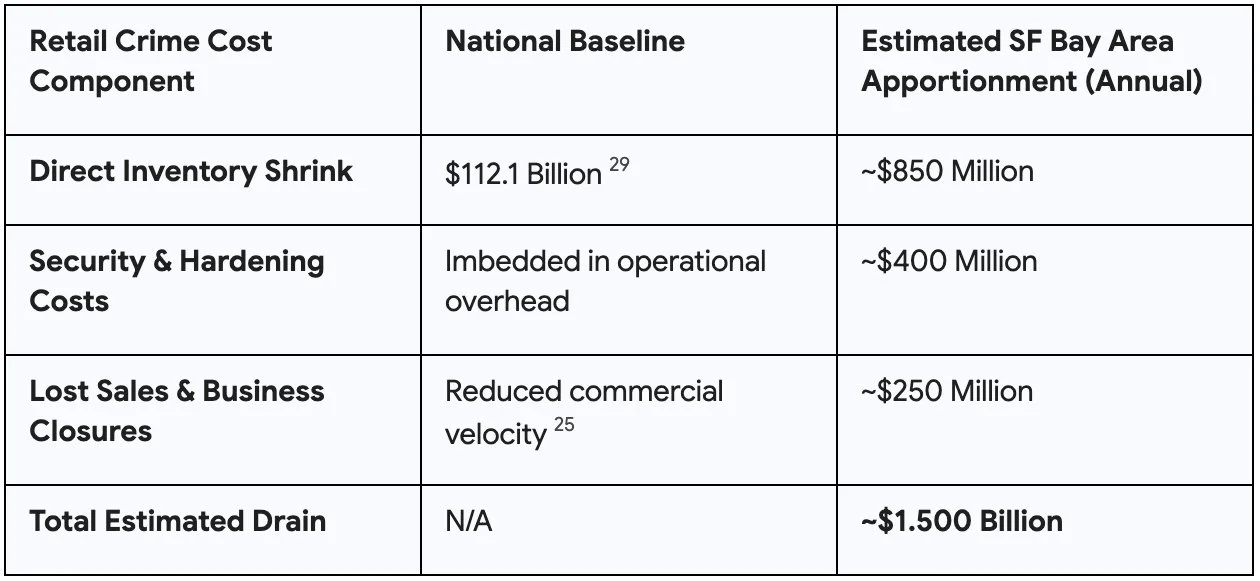
Nationally, retail shrink accounted for an estimated \$112.1 billion in losses. If we allocate a proportional burden to the San Francisco metropolitan area based on GDP contribution and heightened crime indices, the localized economic drain easily exceeds \$1.5 billion annually in direct inventory loss, security hardening costs, and lost commercial velocity.
3. The Destruction of Human Capital ($H$): The Fentanyl Crisis
The most severe degradation of the institutional social contract is the opioid and fentanyl crisis, heavily concentrated in specific San Francisco neighborhoods like the Tenderloin and South of Market (SOMA). The legal and political environment in San Francisco has historically prioritized ideological "harm reduction"—focusing on the distribution of drug paraphernalia and the prevention of immediate fatal overdose—while explicitly de-prioritizing law enforcement against open-air drug markets and cartel distribution networks.
The human toll has been catastrophic, representing a massive destruction of the city's human capital ($H$) and labor force ($L$). In 2023, San Francisco recorded a record 810 accidental drug overdose deaths, the vast majority involving synthetic fentanyl. While preliminary figures show a decline to approximately 635 deaths in 2024 and an estimated 624 deaths in 2025 (largely due to increased law enforcement crackdowns and the expansion of buprenorphine access via a nighttime pilot program), the death toll remains historically anomalous. Toxicological reports confirm the continued presence of highly lethal adulterants like fluoro fentanyl, xylazine (tranq), and bromazolam, complicating treatment and driving mortality.
To model the economic cost of this crisis with academic rigor, we apply the methodology utilized by the White House Council of Economic Advisers (CEA). The CEA models the Value of a Statistical Life (VSL) in the United States at \$13.0 million (adjusted to 2025 dollars). Beyond the direct loss of life, the model accounts for the loss of labor force productivity, staggering healthcare system burdens, and associated crime-related expenses, which add significant proportional costs. Nationally, the CEA estimates the total cost of the opioid epidemic at an unfathomable \$1.11 trillion.
Applying this rigorous economic valuation to San Francisco specifically yields the following localized cost model:
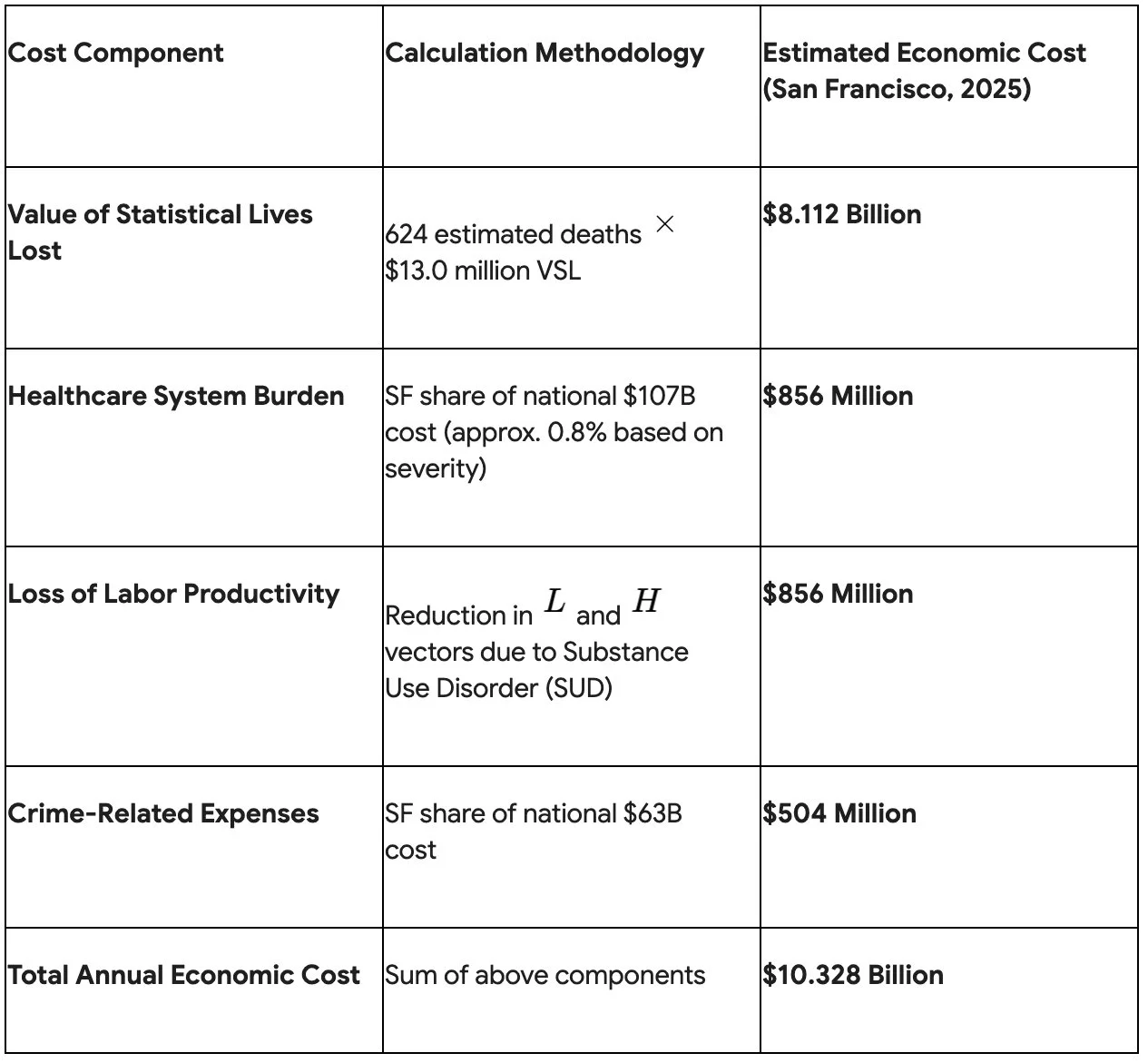
Sources: Office of the Chief Medical Examiner ; White House CEA Opioid Report.
The fentanyl crisis is not merely a public health tragedy; under the Capacity-Based Monetary Theory framework, it is the systemic, ongoing destruction of the aggregate labor pool and human capital. An annual economic bleed of over $10.3 billion critically impairs the city's capacity to generate future impact, representing the ultimate failure of the institutional realization rate.
4. Fiscal Collapse and the Evaporation of the Solow Residual
The cumulative effect of a broken housing market, rampant retail theft, and the public health catastrophe is a mass exodus of the tax base. The agglomeration premium of San Francisco—the willingness of elite corporations and individuals to pay exorbitant costs to access the dense talent network—has collapsed. The Hamilton Filter has detected the regime shift, and capital has fled.
This is most evident in the commercial real estate sector. The city has experienced a net negative absorption of 7.5 million square feet of office space, and the overall vacancy rate sits at a staggering 31.6%. This commercial hollowing out has profound, immediate fiscal implications. As office buildings are reassessed at vastly lower values, property tax revenues plummet. Furthermore, the departure of over 31,000 tech jobs from the city proper has severely reduced payroll and gross receipts business tax revenues.
As a direct consequence, the San Francisco City Controller projected a massive budget deficit of \$817.5 million for the fiscal years 2025–2026 and 2026–2027, growing to nearly $1 billion by 2027-2028—the largest expected deficit in the city's history. To close this gap, Mayor Daniel Lurie's recently proposed \$15.9 billion budget required the elimination of over 1,400 city positions (mostly vacant) and the rolling back of \$100 million in community grants to pre-COVID levels, while setting aside \$400 million in reserves to protect against federal volatility.
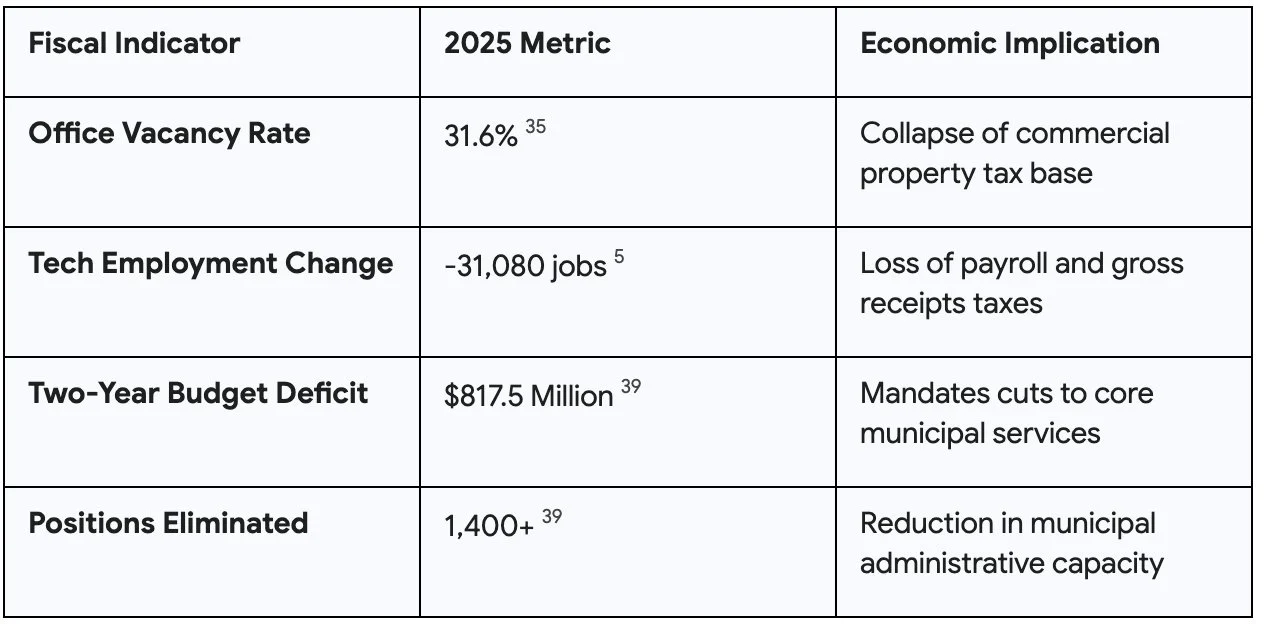
This fiscal crisis creates a classic urban doom loop: falling revenues mandate cuts to basic city services (such as street cleaning, transit, and public safety), which further degrades the physical environment, prompting more businesses and taxpayers to leave, thereby causing revenues to fall even further. The legal environment's inability to adapt to this reality—due to charter-mandated spending minimums and entrenched labor contracts—prevents the agility required to survive the downturn.
Conclusion
The San Francisco Bay Area is currently suffering from a severe, structural depression of its Institutional Realization Rate. According to Capacity-Based Monetary Theory, the region possesses unparalleled theoretical economic capacity—driven by an elite labor force, massive venture capital accumulation, and world-class technological efficiency. However, this capacity is being systematically diluted and destroyed by a broken legal and political environment characterized by an antiquated, 548-page city charter, a labyrinthine permitting process, and an unaccountable political machine that extracts rents through nonprofit corruption while surrendering public spaces to the Hobbesian forces of crime and synthetic opioid addiction.
The explicit economic costs of this institutional decay are existential. The housing permitting bureaucracy extracts nearly $4 billion in deadweight loss from the economy by infinitely delaying the accumulation of physical capital. The organized retail theft epidemic drains over \$1.5 billion annually in shrink, security hardening, and lost tax revenue. Most devastatingly, the fentanyl crisis destroys over \$10.3 billion annually in human capital, labor productivity, and statistical life value. Cumulatively, these cascading failures have collapsed the region's agglomeration premium, resulting in a 31.6% commercial office vacancy rate, the loss of over 31,000 tech jobs, and a nearly \$1 billion structural municipal budget deficit.
However, the trajectory of decline is reversible. By understanding municipal value as a priced claim on expected future impact, policymakers, tech leaders, and civic organizers have a clear, overriding mandate: they must ruthlessly eliminate the frictional costs of trust and order. This requires enacting the SPUR "Charter for Change" to centralize executive accountability , heavily streamlining the 115 bloated city commissions , bypassing CEQA through aggressive state-level by-right housing laws , and fully funding technological force-multipliers like ALPR networks for law enforcement.
Through the rigorous mobilization of a parallel civic infrastructure—funded by pragmatic leaders like Garry Tan and executed through data-driven voter education by groups like GrowSF—the Bay Area electorate can dismantle the entrenched political machine. By restoring the rule of law, streamlining the bureaucracy, and allowing the free, unhindered accumulation of physical and human capital, the region can reestablish its institutional social contract, reverse the Hamiltonian collapse regime, and secure its position as the premier engine of economic impact in the 21st century.
-
CBMT
Y Combinator CEO Garry Tan launches dark-money group to influence California politics, accessed March 4, 2026, https://missionlocal.org/2026/02/sf-garry-tan-california-politics-garrys-list/
The Tech Plutocrats Dreaming of a Right-Wing San Francisco | The New Republic, accessed March 4, 2026, https://newrepublic.com/article/178675/garry-tan-tech-san-francisco
Y Combinator CEO Garry Tan's War on San Francisco Politics Has Only Just Begun - Reddit, accessed March 4, 2026, https://www.reddit.com/r/bayarea/comments/16tobva/y_combinator_ceo_garry_tans_war_on_san_francisco/
Budget Briefing December 2025 Update - San Francisco - SFMTA, accessed March 4, 2026, https://www.sfmta.com/media/44482/download?inline
Corruption in the United States - Wikipedia, accessed March 4, 2026, https://en.wikipedia.org/wiki/Corruption_in_the_United_States
The New York Times lauds Garry Tan—and it's really pathetic - 48 Hills, accessed March 4, 2026, https://48hills.org/2024/04/the-new-york-times-lauds-garry-tan-and-its-really-pathetic/
accessed December 31, 1969, https://garryslist.org/posts/the-sf-chinatown-grift-explained
accessed December 31, 1969, https://garry.substack.com/p/the-sf-chinatown-grift-explained
BOARD OF SUPERVISORS CITY AND COUNTY OF SAN, accessed March 4, 2026, https://sfbos.org/sites/default/files/bag090418_agenda.pdf
March 5, 2024 - SF.gov, accessed March 4, 2026, https://www.sf.gov/sites/default/files/2024-01/M24_EN_VIP_web.pdf
Chinatown, San Francisco - Wikipedia, accessed March 4, 2026, https://en.wikipedia.org/wiki/Chinatown,_San_Francisco
Charter for Change | SPUR, accessed March 4, 2026, https://www.spur.org/publications/policy-brief/2025-11-10/charter-change
Empowering San Francisco's government through charter reform - SPUR, accessed March 4, 2026, https://www.spur.org/sites/default/files/2025-11/SPUR_Charter_for_Change.pdf
Charter Reform - SF.gov, accessed March 4, 2026, https://media.api.sf.gov/documents/Charter_Reform_Update_for_LBEAC_02.05.pdf
Charter Reform Working Group - SF.gov, accessed March 4, 2026, https://media.api.sf.gov/documents/Charter_Reform_Working_Group_-_Feb_5_Meeting_Slides_7KhsTap.pdf
San Francisco's permitting backlog just hit 664 days. : r/BayAreaRealEstate - Reddit, accessed March 4, 2026, https://www.reddit.com/r/BayAreaRealEstate/comments/1qje91p/san_franciscos_permitting_backlog_just_hit_664/
SF Is Building Few New Homes Despite Looser Rules. Will One More Change Start the Flow? - The Frisc, accessed March 4, 2026, https://thefrisc.com/sf-is-building-few-new-homes-despite-looser-rules-will-one-more-change-start-the-flow/
State Releases Accountability Report on San Francisco's Housing Policies and Practices, accessed March 4, 2026, https://www.hcd.ca.gov/about-hcd/newsroom/state-releases-accountability-report-on-san-franciscos-housing-policies-and-practices
city and county of san francisco board of supervisors - budget and legislative analyst, accessed March 4, 2026, https://sfbos.org/sites/default/files/BLA.Zurich_4_Pillars.111924.a.pdf
GrowSF: The #1 voter guide in San Francisco, trusted by hundreds of thousands of San Franciscans | GrowSF.org, accessed March 4, 2026, https://growsf.org/
California Planning and Development Report: CP&DR News Briefs November 4, 2025: San Francisco "Family Zoning;" Housing Costs; Los Angeles Co. Depopulation; and More | USC Lusk, accessed March 4, 2026, https://lusk.usc.edu/news/california-planning-and-development-report-cpdr-news-briefs-november-4-2025-san-francisco
How Costly Is Permitting in Housing Development? - Evan Soltas, accessed March 4, 2026, https://evansoltas.com/papers/Permitting_SoltasGruber2026.pdf
SF must create 82,000 new homes in 8 years. The city is already behind, accessed March 4, 2026, https://www.sfchronicle.com/projects/2023/san-francisco-housing/
Retail Crime, Cargo Theft Impact Businesses, Consumers Across the Country, accessed March 4, 2026, https://www.uschamber.com/economy/retail-crime-cargo-theft-impacts-businesses-and-consumers-across-the-country
With new laws and 800 new arrests, CHP keeps taking down organized retail theft operations statewide | Governor of California, accessed March 4, 2026, https://www.gov.ca.gov/2025/11/04/with-new-laws-and-800-new-arrests-chp-keeps-taking-down-organized-retail-theft-operations-statewide/
Overall Crime in California Fell Last Year, but Shoplifting Continued to Rise, accessed March 4, 2026, https://www.ppic.org/blog/overall-crime-in-california-fell-last-year-but-shoplifting-continued-to-rise/
Retail theft crackdown keeps delivering results: 25,675 arrests and $190 million in recovered stolen goods | Governor of California, accessed March 4, 2026, https://www.gov.ca.gov/2025/11/06/retail-theft-crackdown-keeps-delivering-results-25675-arrests-and-190-million-in-recovered-stolen-goods/
25 Shocking Retail Theft Statistics: In-Depth Review (2025) - Safe and Sound Security, accessed March 4, 2026, https://getsafeandsound.com/blog/retail-theft-statistics/
Tracking San Francisco's drug overdose epidemic, accessed March 4, 2026, https://www.sfchronicle.com/projects/san-francisco-drug-overdose-deaths/
San Francisco overdose deaths plummet, accessed March 4, 2026, https://www.sfcommunityhealth.org/newsroom/san-francisco-overdose-deaths-plummet
Jan24-Jan25 XLS Report.xlsx - SF.gov, accessed March 4, 2026, https://media.api.sf.gov/documents/2025_02_OCME_Overdose_Report.pdf
Jan24-Dec24 XLS Report.xlsx - SF.gov, accessed March 4, 2026, https://www.sf.gov/sites/default/files/2025-01/2025%2001_OCME%20Overdose%20Report.pdf
The Staggering Cost of the Illicit Opioid Epidemic in the United States - The White House, accessed March 4, 2026, https://www.whitehouse.gov/articles/2025/03/the-staggering-cost-of-the-illicit-opioid-epidemic-in-the-united-states/
SAN FRANCISCO OFFICE - Kidder Mathews, accessed March 4, 2026, https://kidder.com/wp-content/uploads/market_report/office-market-research-san-francisco-2025-2q.pdf
Balancing San Francisco's Budget, Part 1: The Budget Process | SPUR, accessed March 4, 2026, https://www.spur.org/news/2025-05-02/balancing-san-franciscos-budget-part-1-budget-process
CITY AND COUNTY OF SAN FRANCISCO - SF.gov, accessed March 4, 2026, https://media.api.sf.gov/documents/March_Update_FY_25-26_through_FY_29-30_03.31.25_FINAL.pdf
Mayor Lurie Signs Balanced, Responsible Budget Driving San Francisco's Recovery | SF.gov, accessed March 4, 2026, https://www.sf.gov/news-mayor-lurie-signs-balanced-responsible-budget-driving-san-franciscos-recovery
New Budget Preserves Services, Cuts 1400 Positions, Closes $817.5M Deficit | GrowSF.org, accessed March 4, 2026, https://growsf.org/news/2025-05-30-budget/
Status of the San Francisco Economy: November 2025 | SF.gov, accessed March 4, 2026, https://media.api.sf.gov/documents/Status_of_the_San_Francisco_Economy_November_2025.pdf
Urbanist think tank SPUR unveils plans to revamp S.F. charter - Mission Local, accessed March 4, 2026, https://missionlocal.org/2025/11/spur-sf-charter-reform/
About GrowSF, accessed March 4, 2026, https://growsf.org/about/
Charter Reform Working Group | SF.gov, accessed March 4, 2026, https://www.sf.gov/charter-reform-working-group
RECENT LEGISLATIVE ACTIONS TO INCREASE HOUSING PRODUCTION IN CALIFORNIA1, accessed March 4, 2026, https://shou.senate.ca.gov/system/files/2025-02/recent-leg-actions-factsheet-updated-feb-2025_0.pdf
California continues to have the highest cost of living — due to our severe housing shortage. Let's change that. : r/sanfrancisco - Reddit, accessed March 4, 2026, https://www.reddit.com/r/sanfrancisco/comments/1j3l5o1/california_continues_to_have_the_highest_cost_of/
Family Zoning Plan: Economic Impact Report - SF.gov, accessed March 4, 2026, https://media.api.sf.gov/documents/250700_economic_impact_final.pdf
Organized Retail Theft Grant Programs - Annual Summary Report for Quarters 1 through 5 October 2023 to December 2024 - California Board of State and Community Corrections - CA.gov, accessed March 4, 2026, https://www.bscc.ca.gov/wp-content/uploads/2025/04/ORT-Annual-Report-April-2025_FINAL.pdf

Capacity-Based Monetary Theory and California's Institutional Friction: An Exhaustive Analysis of Legal Procedures and Reform in Orange County
When viewed through the rigorous framework of Capacity-Based Monetary Theory, the legal and procedural weaknesses in California and Orange County are not merely isolated administrative flaws; they are profound macroeconomic constraints that artificially suppress the state's Expected Future Impact.
The severe civil litigation backlogs that lock up capital, the tragic inefficiency of the pro se experience that destroys wealth, the drafting ambiguities in small business contracts, the existential valuation threats of PAGA and CCPA liabilities in M&A, and the catastrophic capital burn of CEQA-delayed infrastructure projects like the OC Streetcar all serve to violently lower the Institutional Realization Rate (). When the legal framework fails to provide swift, predictable, and low-cost resolution to human interaction, transaction costs approach infinity, the future discount rate spikes, and the economic engine stalls.
However, this trajectory is entirely reversible. By aggressively championing and implementing voter-friendly reforms—such as the permanent expansion of Informal Discovery Conferences, the integration of algorithmic "Courthouse AI," the adoption of plain-language business templates, and the passage of the 2026 Building an Affordable California Act (BACA)—California can radically repair its institutional software. By doing so, the state will secure its legal infrastructure, drastically lower the transactional friction that plagues its entrepreneurs, and finally unleash the extraordinary, latent productive capacity of its human and physical capital.
1. Introduction: The Jurisprudence of Economic Capacity
The fundamental stability and valuation of any regional or national economy are inextricably linked to the efficiency, predictability, and reliability of its legal and institutional frameworks. To accurately diagnose and understand the profound economic consequences of procedural inefficiencies within California's legal system—with a specific, granular focus on the Superior Court of Orange County—it is necessary to transcend traditional neoclassical economics and view these systems through the analytical lens of Capacity-Based Monetary Theory (CBMT).
CBMT proposes a radical departure from standard functional definitions of economic value. Instead of viewing money merely as a medium of exchange or a unit of account, CBMT asserts that money is a floating-price claim on the expected future productive capacity of a society. This productive capacity is not a static reservoir of wealth but a dynamic vector function. It is governed by the aggregate labor of the population ($L$), the efficiency of that labor as amplified by human capital and technology ($H$ and $A$), and, crucially, the stability of the institutional social contract that allows this labor to project value into the future without being consumed by transaction costs. In the double-entry bookkeeping of a civilization, the asset backing the liability of circulating capital is the Expected Future Impact of the society.
The legal system acts as the foundational "software" required to operate this economic "hardware". Thomas Hobbes described the theoretical "state of nature" as a condition of perpetual war, which, translated into economic terms, represents a regime of infinite transaction costs. In such a state, capital cannot form because no rational agent will exchange present, tangible goods for a future promise if the future is characterized by unpredictable expropriation, interminable delays, or unresolvable disputes. The state—the "Leviathan"—imposes order, and the effectiveness of this order is mathematically quantified by the Institutional Realization Rate ($\rho$). When $\rho = 1$, a society's theoretical productive capacity is fully realizable, meaning disputes are resolved instantly and contracts are perfectly enforced. However, when legal procedures become excessively complex, heavily backlogged, or stochastically unpredictable, $\rho$ declines precipitously. Capital is therefore "burned," not as a rational, costly signal of high capacity—as described by Amotz Zahavi’s Handicap Principle—but as pure deadweight loss consumed by procedural and bureaucratic friction.
To rigorously define the economic impact of legal inefficiencies across California, we utilize the Augmented Solow-Swan model as specified by Mankiw, Romer, and Weil (1992), which serves as the core mathematical foundation for CBMT. The production function for societal "Impact" ($Y$) is expressed as $Y = A K^\alpha H^\beta L^{1-\alpha-\beta}$, where $K$ is physical capital, $H$ is human capital, $L$ is the labor force, and $A$ is labor-augmenting technology. Because theoretical output is meaningless if it cannot be legally secured, CBMT introduces the Institutional Realization Rate ($\rho$), creating the formula for Realizable Impact ($Y_R$): $Y_R = \rho (A K^\alpha H^\beta L^{1-\alpha-\beta})$.
| CBMT Variable | Macroeconomic Definition | Legal System Equivalent in California | Economic Impact of Procedural Inefficiency |
|---|---|---|---|
| $H$ | Human Capital | Litigants, attorneys, and specialized labor navigating the legal system. | Wasted labor hours navigating complex local rules; unrepresented pro se litigants operating at a massive disadvantage. |
| $A$ | Efficiency / Technology | Procedural tools, contract drafting standards, and court automation. | Reliance on outdated "encrusted" contract terms; slow technological integration in courts leading to process failures. |
| $K$ | Physical Capital | Real estate, infrastructure, and corporate assets tied up in disputes. | Development halted by environmental litigation; transit funds incinerated by bureaucratic mismanagement. |
| $\rho$ | Institutional Realization | Court backlogs, judicial availability, and the speed of dispute resolution. | As backlogs grow, $\rho$ drops, increasing the discount rate applied to future claims and reducing the present value of all state assets. |
When the legal system functions optimally, it minimizes transaction costs, thereby maximizing $\rho$. Conversely, when a system is plagued by multi-year delays and unpredictability, market participants lose confidence in the passage of time required to redeem their claims. In a stochastic environment where regime-switching models, such as the Hamilton Filter, detect a rising probability of institutional failure, the discount rate applied to future cash flows spikes, and the fundamental value of investments collapses.
This exhaustive research report applies the CBMT framework to the current state of legal procedures in California, focusing intently on Orange County. By examining civil litigation backlogs, the economic destruction caused by the pro se representation crisis, transactional contract friction for small businesses, the M&A regulatory burdens of the Private Attorneys General Act (PAGA) and the California Consumer Privacy Act (CCPA), and the catastrophic capital misallocation in public transit projects governed by the California Environmental Quality Act (CEQA), a distinct pattern emerges. The Institutional Realization Rate in California is artificially depressed by systemic procedural failures. Following this diagnostic analysis, the report identifies actionable, voter-friendly methodologies designed to restore institutional efficiency, minimize transaction costs, and maximize the region's Expected Future Impact.
2. The Breakdown of the Leviathan: Systemic Civil Litigation Backlogs
The most direct and visible indicator of a declining Institutional Realization Rate is the inability of the sovereign state to resolve civil disputes in a timely, predictable manner. The Superior Court of Orange County, alongside the broader California judicial branch, is currently facing a severe structural imbalance between the demand for judicial intervention and the supply of funded judicial resources.
2.1. Statistical Evidence of Institutional Friction in Orange County
The civil litigation backlog in Orange County has reached critical levels that severely undermine the efficacy of the Leviathan. Within the 2024-2025 fiscal year, the Orange County Superior Court saw an influx of over 2,000 new civil filings. These new filings joined an already staggering backlog of 862 active matters, all of which were placed under the jurisdiction of a mere 24 civil judges. The sheer mathematical impossibility of adjudicating these highly complex business, tort, and family disputes effectively has resulted in what local legal practitioners accurately describe as absolute "procedural gridlock".
This localized failure is symptomatic of a massive statewide crisis. In 2022 and 2023, California state courts added more than 50 times as many civil cases to their backlog as all United States District Courts combined. Over one million civil cases have been added to the California backlog over the last five years alone, and Unlimited Civil case filings have exceeded dispositions every single year since 2013. In each of the last three years, the number of Unlimited Civil cases filed was more than double the number of Unlimited Civil cases closed. Consequently, state courts have consistently failed to meet their mandated case processing goals, which dictate a 100% disposition rate within 24 months, 85% within 18 months, and 75% within 12 months.
| Jurisdiction / Metric | Key Backlog Statistic (2024-2025 Data) | Systemic Consequence |
|---|---|---|
| Orange County Civil Panel | 2,000+ new filings added to 862 active matters across only 24 judges. | Severe procedural gridlock; delayed discovery and trial dates. |
| California Statewide Civil | 1,000,000+ cases added to the backlog over a 5-year period. | Complete failure to meet 12-month, 18-month, and 24-month disposition goals. |
| Trial Date Adherence | Trials fail to proceed on originally scheduled dates approximately 85% of the time. | Massive inflation of legal fees; forced settlement conferences under duress. |
| State Budget Deficit Impact | \$46.8 billion state deficit triggering a 7.95% judicial branch funding reduction. | \$97 million cut to trial courts statewide; Orange County absorbs a \$3.04 million ongoing cut. |
The practical reality for civil litigators and their clients is dire. Trials rarely proceed on their originally scheduled dates, with some practitioners noting that dates are vacated up to 85% of the time due to unavailable courtrooms. This unreliability strips the legal process of its deterrent effect.
2.2. The CBMT Ramifications of Judicial Delay
From the perspective of Capacity-Based Monetary Theory, these multi-year delays are not merely administrative inconveniences to be managed; they are direct destroyers of economic value. A delayed trial extends the period of uncertainty regarding the ownership, valuation, and allocation of both physical ($K$) and human ($H$) capital.
When a breach of contract dispute or a real estate partition action languishes in the Orange County Superior Court for three to five years, the capital tied up in that dispute cannot be redeployed into the broader economy. The discount rate applied to the disputed assets rises exponentially because the time-value of the resolution is severely degraded. Furthermore, the state budget deficit of \$46.8 billion in 2024 led to a 7.95% reduction in judicial branch funding, translating to a \$97 million statewide reduction for trial courts. Orange County’s share of this ongoing statewide reduction is \$3.04 million, further choking an already starved system. This budgetary constriction signals a Hamilton Filter regime shift to the broader market: economic actors perceive that the state is losing its capacity to fund the very infrastructure required to enforce the social contract. When the market realizes the Leviathan can no longer guarantee the passage of time required to redeem a claim, investment capital flees to jurisdictions with a higher Institutional Realization Rate.
3. The Human Capital Penalty: Pro Se Litigants and Asymmetric Information
A core tenet of Gary Becker’s allocation theories, which are deeply integrated into the CBMT production function, is that human capital ($H$) is not a fungible commodity but a specialized asset class requiring constant investment and efficient allocation. The California legal system systematically misallocates and destroys human capital by forcing untrained individuals to navigate highly complex, specialized institutional structures without adequate technological or legal support.
3.1. The Scope and Demographics of the Pro Se Crisis
In the United States, approximately 20 million civil cases are filed annually, and a staggering 75% of these involve at least one party who lacks legal representation—commonly referred to as a "pro se" or "pro per" litigant. In specific areas of practice, such as family law, this metric is even more pronounced. In California, 70% of divorce petitions involve a self-represented litigant at the very beginning of the case, and this figure increases to 80% by the time of judgment.
These high-volume cases are not trivial; they frequently involve high-consequence economic matters such as debt collection, unlawful detainers (evictions), and mortgage foreclosures. Pro se litigants are generally from lower income brackets and face significant language and education barriers. They are thrust into a system governed by the California Rules of Court and highly specific local regulations, such as Division 3 (Civil Rules) and Division 7 (Family Law Rules) of the Orange County Superior Court. For instance, under Orange County Local Rule 700.7, mandatory electronic filing is highly regulated, and while self-represented parties are technically exempt, the pressure to conform to the digital infrastructure without adequate training creates immense friction.
3.2. Default Judgments, O-Ring Failures, and Wealth Destruction
Michael Kremer’s O-Ring Theory of Economic Development demonstrates that in highly complex production processes, a single mistake by a low-skill participant can destroy the value of the entire operational chain. The civil litigation process is the ultimate O-Ring environment; it is highly intolerant of minor procedural errors. Pro se litigants routinely fail to meet strict formatting standards, miss rigid evidentiary deadlines, or fail to respond to initial complaints altogether. This leads to an exceptionally high rate of default judgments.
Statistical analyses indicate the devastating nature of this asymmetry: in federal district courts, pro se plaintiffs win only about 3% of their final judgments, while pro se defendants secure favorable outcomes only 12% of the time. In contrast, when both parties are represented by counsel, the win percentages normalize. When defendants fail to appear or navigate the procedural labyrinth correctly, the court issues default judgments that are often legally flawed, factually unwarranted, and economically catastrophic.
| Pro Se Litigant Challenge | CBMT Economic Framework Implication | Real-World Consequence in California Courts |
|---|---|---|
| Lack of Substantive Legal Knowledge | Severe deficit in specific Human Capital ($H$) required to operate the legal "software." | Litigants lose 88% to 97% of cases; high vulnerability to predatory debt collection practices. |
| Procedural Complexity (e.g., OCLR 700.7) | O-Ring Theory failure; one minor procedural defect destroys the entire legal claim. | Cases dismissed on technicalities rather than merits; unjust default judgments entered automatically. |
| Inadequate Technological Access | Failure to leverage efficiency multipliers ($A$). | Inability to properly format, electronically serve, or file PDF documents, leading to systemic exclusion. |
This dynamic represents a complete failure of the Institutional Realization Rate ($\rho$). The justice system ceases to act as an impartial arbiter of truth and instead functions as an automated processor of asymmetric information, actively stripping wealth and assets from individuals solely due to their lack of specialized human capital. The result is a cascading economic failure: unjust evictions remove individuals from the localized labor force ($L$), and unwarranted debt collections destroy their ability to accumulate physical capital ($K$). While Orange County has attempted to mitigate this through Self-Help Services at the Central Justice Center and Lamoreaux Justice Center, the sheer volume of 12,000 remote litigants overwhelming the system demonstrates that human-led triage is mathematically insufficient to solve the crisis.
4. Transactional Friction: The Drag on Small Business Capacity and Contract Innovation
The creation of future impact ($Y$) in an economy is highly dependent on the velocity and security of daily business transactions. In Orange County, small businesses face severe legal hurdles that artificially inflate transaction costs, preventing the optimal allocation of resources.
4.1. Contract Drafting Inefficiencies and the Persistence of "Encrusted" Terms
Transactional lawyers are theorized to act as practitioners of preventive law, drafting agreements that eliminate ambiguity and preemptively resolve conflicts to prevent future litigation. However, empirical studies into commercial contract drafting reveal a pervasive, systemic reliance on "sticky and encrusted terms". Rather than innovating or updating clauses to reflect new statutory developments or shifting economic realities, transactional attorneys frequently regurgitate historical precedent simply to avoid the risk of drafting original language.
This adherence to outdated boilerplate templates introduces immense economic vulnerability. For small businesses operating in Orange County, relying on poorly drafted or generalized templates often leads to vague language regarding deliverables, a failure to anticipate dispute resolution mechanisms, and the inadvertent inclusion of highly punitive arbitration clauses or one-sided attorney's fee provisions. Under the CBMT framework, these drafting inefficiencies represent a severe degradation of the technology and efficiency multiplier ($A$). Instead of seamless integration and zero-trust commerce, businesses enter into fragile agreements that, when tested by real-world stressors, shatter and spill over into the heavily backlogged litigation system, further depressing $\rho$.
4.2. Legislative Shocks: SB 1103 and the Commercial Tenant Protection Act
The regulatory environment governing commercial transactions in California is highly volatile, requiring constant legal vigilance that drains capital from productive use. A prime example is the implementation of California Senate Bill 1103 (SB 1103), effective January 1, 2025. Enacted into the Civil Code, the Commercial Tenant Protection Act extends protections previously reserved for residential tenants to "Qualified Commercial Tenants" (QCTs).
To qualify as a QCT under the new law, a business must affirmatively provide written notice and self-attestation to their landlord that they meet specific size thresholds, commonly referred to as the "5/10/20 rule".
| Entity Type | SB 1103 QCT Employee Threshold | Key New Protections Required in Leases |
|---|---|---|
| Microenterprise | 5 or fewer employees (lacking capital access) | 30-day notice for rent hikes $\le$ 10%; 90-day notice for hikes > 10%. |
| Restaurant | 10 or fewer employees | Strict limitations on passing through building operating costs; 18-month lookback limits. |
| Nonprofit Organization | 20 or fewer employees | Mandatory language translation of the lease into the tenant's primary language. |
Commercial landlords in Orange County who utilize outdated standard leases will find themselves in immediate breach of SB 1103. For instance, the law prohibits landlords from charging QCTs for building operating costs that were not incurred within the previous 18 months or reasonably expected within the next 12 months. Furthermore, costs must be allocated strictly by square footage rather than arbitrary fixed fees.
While organizations like Public Counsel have proactively drafted a 2025 Model Commercial Lease to accommodate these changes, the vast majority of small business owners lack the legal counsel required to implement them. This regulatory whiplash forces small businesses and landlords to divert capital away from hiring ($L$) and expansion ($K$) and into legal compliance fees, lowering the overall efficiency ($A$) of the local economy.
5. The Stochastic Risk Premium in M&A: Regulatory Frictions from PAGA and CCPA
In the realm of Mergers and Acquisitions (M&A), venture capitalists and acquiring firms are essentially underwriting the Expected Future Impact of a target company. They are placing a highly calculated bet entirely on the target firm's human capital ($H$) and its ability to generate a high Solow Residual ($A$) post-acquisition. However, California's unique, highly punitive regulatory landscape injects severe stochastic risk into these valuations, forcing acquirers to apply a massive discount rate to California-based targets.
5.1. The Private Attorneys General Act (PAGA) as an Institutional Penalty
Enacted in 2004, PAGA (Labor Code § 2698) authorizes "aggrieved employees" to act as private attorneys general, suing employers for labor code violations on behalf of the State of California and other employees. Because PAGA claims function as pseudo-class actions but bypass the rigorous certification rules of traditional class actions, they have exploded in volume. Prior to recent reforms, a single employee could sue over a laundry list of technical violations (e.g., minor errors on a pay stub) that they had not personally experienced, triggering astronomical stacked penalties ranging from \$50 to \$200 per pay period per employee. PAGA settlements in California exceeded \$500 million in 2024 alone.
This dynamic creates a terrifying environment for M&A due diligence. Acquiring entities must price in the risk that a target firm possesses millions of dollars in undiscovered PAGA liability. In 2024, the state legislature passed AB 2288 and SB 92 to reform the system, creating a compromise to keep a repeal initiative off the ballot.
| PAGA Metric | Pre-2024 Reform Status | Post-2024 Reform Status (AB 2288 / SB 92) | M&A Valuation Impact |
|---|---|---|---|
| Standing to Sue | Plaintiff could sue for violations they did not personally experience. | Plaintiff must have personally suffered the specific Labor Code violation within the last year. | Reduces exposure to frivolous, broad-discovery "fishing expeditions" during M&A. |
| Penalty Allocation | 75% to the State (LWDA), 25% to the aggrieved employees. | 65% to the State (LWDA), 35% to the aggrieved employees. | Modestly increases direct worker compensation but maintains heavy state extraction. |
| Penalty Caps & Cures | Unlimited stacking of penalties for derivative violations. | \$50,000 cap for compliant employers; expanded 33-day right to cure for employers < 100 employees. | Allows acquiring firms to immediately audit and cure defects, capping post-merger liability. |
While these reforms provide a procedural tool for manageability, PAGA still represents a significant deadweight transaction cost. Employers must spend vast amounts of capital conducting proactive payroll audits to qualify for the penalty caps, diverting resources from productive investment.
5.2. Data Privacy (CCPA) and the Destruction of IP Protection
The evolving landscape of data privacy and employment mobility further complicates California transactions. The California Consumer Privacy Act (CCPA), as amended by the CPRA, imposes strict data handling requirements on businesses with over \$26.6 million in gross revenue or those processing data for over 100,000 consumers. In the context of M&A, recent regulations such as AB 1824 (effective January 2025) mandate that any business acquiring personal information through a merger must honor all previous consumer opt-out requests made to the seller.
Furthermore, the California Privacy Protection Agency (CPPA) finalized sweeping new regulations effective in 2026, requiring rigorous risk assessments and annual cybersecurity audits for the use of Automated Decision-Making Technology (ADMT). Fines for CCPA violations have increased to \$2,663 for standard violations and up to \$7,988 for intentional violations involving the data of minors. Acquirers must meticulously audit a target's ADMT systems, knowing that non-compliance will trigger devastating fines.
Finally, California's absolute ban on non-compete agreements, expanded at the end of 2023 via Business and Professions Code section 16600.5, renders non-compete provisions void "regardless of where and when the contract was signed". This nullifies standard asset protection strategies utilized in M&A to preserve a target firm's proprietary goodwill and human capital. Because acquiring firms cannot legally lock in the key talent that generated the target's value, the valuation of the target's Human Capital ($H$) is severely degraded.
6. Physical Capital Collapse: CEQA Weaponization and the OC Streetcar
Perhaps nowhere is the failure of the Institutional Realization Rate more spectacularly visible than in California's public transit and infrastructure projects. The theoretical capacity to build infrastructure exists in the physical aggregate labor force ($L$) and technology ($A$), but the legal and bureaucratic framework ensures that capital is incinerated before it can be deployed.
6.1. The OC Streetcar: A Masterclass in Bureaucratic Mismanagement
The Orange County (OC) Streetcar project, designed to link the Santa Ana Regional Transportation Center to Garden Grove over a 4.15-mile route, serves as a prime case study in institutional capital destruction. Initially presented to the federal government in 2015 with a projected cost of \$250 million and an opening date of 2019, the project has been delayed until at least 2026, with current costs ballooning to \$649 million.
At an astronomical \$156 million per mile—nearly double the cost of comparable national projects like the D.C. Streetcar ($83 million/mile)—the OC Streetcar represents a severe misallocation of taxpayer capital. The 2024-2025 Orange County Grand Jury report issued a scathing assessment of the Orange County Transportation Authority (OCTA), citing inaccurate historical utility maps, the discovery of contaminated soil and unmarked Native American burial grounds, and intense legal disputes as primary drivers of the delay. The prime contractor, Walsh Construction, filed a highly unusual civil complaint against OCTA during active construction, alleging inadequate plans and specifications, which prompted a cross-complaint from the agency.
Furthermore, the "hopscotch method" of construction caused devastating, unmitigated economic damage to small businesses along the 4th Street corridor in downtown Santa Ana. Despite pleas from the community, OCTA failed to implement a Business Interruption Fund (BIF). The Grand Jury explicitly contrasted this failure with the Los Angeles Metro, which successfully utilized a \$10 million annual BIF to compensate small businesses impacted by rail construction. Under Zahavi's Handicap Principle within CBMT, burning capital can theoretically act as a signal of surplus capacity. However, the capital burned on the OC Streetcar does not signal high capacity; it signals systemic bureaucratic incompetence. The funds diverted into this project, drawn from the Measure M2 (OC Go) half-cent sales tax, represent capital ($K$) that has been neutralized.
6.2. The Weaponization of CEQA
A primary macro-driver of infrastructure delay across the state is the California Environmental Quality Act (CEQA). Enacted in 1970, CEQA requires public agencies to exhaustively evaluate and mitigate environmental impacts. However, under its existing rules, almost anyone can file anonymous, repetitive lawsuits to halt housing, transit, and clean energy projects.
Empirical studies indicate that following the Great Recession, 87% of CEQA lawsuits targeted infill projects in existing communities rather than greenfield developments. Alarmingly, 70% of challenged units were located within a half-mile of transit services, meaning CEQA is disproportionately used to block the very dense, transit-oriented housing required to meet the state's economic and climate goals. CEQA has mutated from a tool of environmental protection into a regime of infinite transaction costs—a legal weapon used by special interests, competitors, and NIMBY ("Not In My Back Yard") groups to extract union concessions or halt development entirely. The constant threat of litigation forces developers to spend years and millions of dollars generating bulletproof Environmental Impact Reports (EIRs) rather than breaking ground, severely depressing the state's capacity to generate physical capital ($K$).
7. Actionable, Voter-Friendly Methodologies for Institutional Reform
If money is a priced claim on future capacity , California must aggressively optimize its institutional framework to defend the fundamental value of its economy. The following reform methodologies target the specific weaknesses identified in Orange County and the state at large. These solutions are designed to be "voter-friendly"—emphasizing affordability, speed, tax savings, and fundamental fairness.
7.1. Judicial Efficiency: The Expansion of Early Dispute Resolution (EDR)
To dismantle the systemic civil case backlog, courts must shift from a protracted adjudicative model to a collaborative problem-solving model.
The Informal Discovery Conference (IDC) Pilot: The Orange County Superior Court recently launched an IDC pilot program aimed at resolving discovery disputes informally before they require expensive full-motion practice. By centralizing these disputes under a single judge (Hon. Andre De La Cruz), the court achieved a staggering 97% resolution rate, handling over 100 conferences weekly without the need for formal hearings. The program was so successful it was expanded from 5 to 15 courtrooms by January 2026. Voters and policymakers must push to permanently codify and fund this program statewide, as it drastically reduces the time ($T$) attorneys spend litigating minutiae.
Mandatory Early Dispute Resolution (EDR): Legislative efforts like the recently proposed SB 1141 aim to give courts the discretion to order mediation for cases involving up to \$150,000, a massive increase from the outdated \$50,000 threshold established 30 years ago. Expanding mandatory non-binding mediation forces parties to confront the underlying motivations of their dispute early, saving hundreds of trial days and millions in taxpayer-funded judicial resources.
7.2. Technological Augmentation: "Courthouse AI" for Pro Se Litigants
To stem the massive destruction of human capital caused by the pro se crisis, the legal system must aggressively adopt labor-augmenting technology ($A$). Stanford Law Professor David Engstrom notes that Artificial Intelligence presents "massive access-widening potential".
Automated Default Prove-Up Systems: Los Angeles and neighboring courts are partnering with researchers to pioneer AI systems that automatically review default judgments for legal errors before they are entered. This acts as a final safety net, catching up to 10% of problematic judgments and preventing catastrophic losses for unrepresented defendants who make simple procedural errors.
Algorithmic Triage and Guided Interviews: Using platforms like LEAP, Smokeball, and the open-source Suffolk Legal Innovations Lab, courts can deploy guided, plain-language digital interviews. These systems ask litigants simple questions and automatically map the logic to translate a factual story into a perfectly formatted, legally compliant pleading that interfaces directly with Tyler Technologies' e-filing systems.
Voter Messaging: "Courthouse AI" should be pitched to voters as a taxpayer protection and efficiency measure. By preventing courts from becoming bogged down by incorrectly formatted paperwork and frivolous errors, the entire docket moves faster for everyone, ensuring justice is determined by the facts of a case, not by who can afford a \$600/hour procedural expert.
7.3. The Abundance Agenda: Infrastructure and CEQA Reform
To end the destruction of physical capital seen in projects like the OC Streetcar, California must structurally reform CEQA. While the legislature made progress in 2024 and 2025 with AB 130 and SB 131 (which created sweeping, immediate exemptions for urban infill housing up to 20 acres) , these piecemeal exemptions are insufficient to protect large-scale infrastructure.
The Building an Affordable California Act (BACA): Scheduled for the November 2026 ballot and sponsored by the California Chamber of Commerce, BACA is a definitive, voter-friendly initiative. It seeks to comprehensively streamline CEQA for "essential projects," explicitly defined as clean drinking water infrastructure, broadband, clean energy, public health facilities, and affordable housing.
Strict Procedural Timelines: BACA strips away bureaucratic lethargy by mandating that agencies determine application completeness within 30 days; failure to do so means the application is deemed complete by law. Crucially, it sets hard deadlines for environmental review: 365 days for full Environmental Impact Reports (EIRs) and 180 days for Mitigated Negative Declarations (MNDs). It also strictly limits the administrative record to prevent endless litigation discovery loops.
Voter Messaging: The campaign for BACA must lean heavily on the "Abundance Agenda"—the philosophy that governments must remove procedural bottlenecks to build necessary infrastructure. The messaging must articulate that cutting red tape does not mean destroying the environment (BACA explicitly maintains the Clean Air and Clean Water Acts); rather, it means building the green infrastructure and affordable housing the state desperately needs without allowing special interests to hold projects hostage.
7.4. Small Business Safe Harbors: Plain Language and Regulatory Clarification
Small businesses in Orange County lack the massive compliance budgets of mega-corporations, making them highly vulnerable to transactional friction and predatory litigation.
Plain Language Contracting: Federal initiatives like the Plain Writing Act of 2010 have demonstrated that complex legalese can be simplified. State bar associations should champion the widespread adoption of standardized, plain-language commercial templates. A prime example is the new 2025 Model Commercial Lease developed by Public Counsel to help small businesses instantly comply with the complex new SB 1103 tenant protections. Open-source, standardized templates eliminate the drafting ambiguities that inevitably lead to breach-of-contract lawsuits.
Consolidating PAGA Reforms: The 2024 legislative compromises (AB 2288 and SB 92) made significant strides by finally requiring plaintiffs to have actually experienced the violation they are suing over, capping penalties at \$50,000 for employers who proactively comply, and expanding the 33-day right-to-cure window for businesses with fewer than 100 employees.
Voter Messaging: Voters overwhelmingly support systems that prioritize rapid agency enforcement over slow, lawsuit-first approaches. Policymakers must continually audit these PAGA reforms to ensure they function as intended—protecting small businesses from extortionate legal shakedowns while simultaneously guaranteeing that workers receive rapid, direct restitution without forfeiting a massive percentage of their settlements to trial lawyers.
7.5. Electoral Integrity and Democratic Trust
Finally, the bedrock of the Institutional Realization Rate is absolute public trust in the democratic process that elects the Leviathan. The 2026 ballot will feature the California Voter ID Initiative, which mandates government-issued identification for in-person voting and verification of the last four digits of an ID (or Social Security Number) for mail-in ballots, alongside mandatory citizenship audits of the voter rolls. While highly debated—with opponents arguing it may disenfranchise marginalized voters and create identity theft risks —proponents argue it brings California into alignment with standard national security practices, thereby reducing systemic friction and paranoia regarding electoral legitimacy. Similarly, measures like SB 42 (The California Fair Elections Act of 2026) aim to authorize publicly financed campaigns to level the playing field against billionaire influence. Establishing indisputable, transparent procedures in the voting booth ensures that the populace remains confident in the fundamental social contract.
8. Conclusion
When viewed through the rigorous framework of Capacity-Based Monetary Theory, the legal and procedural weaknesses in California and Orange County are not merely isolated administrative flaws; they are profound macroeconomic constraints that artificially suppress the state's Expected Future Impact.
The severe civil litigation backlogs that lock up capital, the tragic inefficiency of the pro se experience that destroys wealth, the drafting ambiguities in small business contracts, the existential valuation threats of PAGA and CCPA liabilities in M&A, and the catastrophic capital burn of CEQA-delayed infrastructure projects like the OC Streetcar all serve to violently lower the Institutional Realization Rate ($\rho$). When the legal framework fails to provide swift, predictable, and low-cost resolution to human interaction, transaction costs approach infinity, the future discount rate spikes, and the economic engine stalls.
However, this trajectory is entirely reversible. By aggressively championing and implementing voter-friendly reforms—such as the permanent expansion of Informal Discovery Conferences, the integration of algorithmic "Courthouse AI," the adoption of plain-language business templates, and the passage of the 2026 Building an Affordable California Act (BACA)—California can radically repair its institutional software. By doing so, the state will secure its legal infrastructure, drastically lower the transactional friction that plagues its entrepreneurs, and finally unleash the extraordinary, latent productive capacity of its human and physical capital.
-
CBMT
Orange County Bar Association, accessed March 4, 2026, https://www.ocbar.org/All-News/News-View/ArticleId/6808/July-2025-President-s-Page-Summertime-and-the-Livin-s-Easy
The case for Early Dispute Resolution to fast-track justice, accessed March 4, 2026, https://www.dailyjournal.com/article/381664-the-case-for-early-dispute-resolution-to-fast-track-justice
Attorneys welcome LA Superior Court reforms but warn backlogs persist - Daily Journal, accessed March 4, 2026, https://www.dailyjournal.com/articles/389157-attorneys-welcome-la-superior-court-reforms-but-warn-backlogs-persist
Approved Budget FY 2025-26 - Orange County Superior Court, accessed March 4, 2026, https://www.occourts.org/system/files/grand-jury/05-28-2019_ocgrandjuryselected_lh.pdf
Judicial Council Allocates Funding to Trial Courts With $97 Million Required Cut, accessed March 4, 2026, https://newsroom.courts.ca.gov/news/judicial-council-allocates-funding-trial-courts-97-million-required-cut
Page 4 - FY 2024-25 Budget Book - Full Version, accessed March 4, 2026, https://www.occourts.org/sites/default/files/oc/default/flipbook/FY%202024-25%20Budget%20Book/Final/Full%20Version/FY%202024-25%20Budget%20Book%20-%20Full%20Version/mod_drupal7_flipbook1/files/basic-html/page4.html
Harnessing AI to Improve Access to Justice in Civil Courts - SLS ..., accessed March 4, 2026, https://law.stanford.edu/press/harnessing-ai-to-improve-access-to-justice-in-civil-courts/
Self-Represented Litigants in Family Law: The Response of California's Courts, accessed March 4, 2026, https://www.californialawreview.org/online/self-represented-litigants-in-family-law
JusticeCorps: Helping Pro Se Litigants Bridge a Divide - Columbia Journal of Law & Social Problems, accessed March 4, 2026, https://jlsp.law.columbia.edu/wp-content/blogs.dir/213/files/2017/03/49-Zuckerman.pdf
Titanic, Hindenburg, DIY appeals - Daily Journal, accessed March 4, 2026, https://www.dailyjournal.com/mcle/1028-titanic-hindenburg-diy-appeals
Rules of Court | Superior Court of California | County of Orange, accessed March 4, 2026, https://www.occourts.org/forms-filing/rules-court
LOCAL RULES – SUPERIOR COURT of CALIFORNIA, COUNTY of ORANGE 7-1 DIVISION 7 FAMILY LAW Rule Effective 700. Subject Matter of t, accessed March 4, 2026, https://www.occourts.org/system/files/local-rules/div7.pdf
eFiling for Family | Superior Court of California | County of Orange, accessed March 4, 2026, https://www.occourts.org/online-services/efiling/efiling-family
Self-Represented Litigants and the Pro Se Crisis - Cornell Law School, accessed March 4, 2026, https://publications.lawschool.cornell.edu/jlpp/2023/11/04/self-represented-litigants-and-the-pro-se-crisis/
Self-Help | Superior Court of California | County of Orange, accessed March 4, 2026, https://www.occourts.org/self-help
Transactional Skills Training: Contract Drafting - Beyond the Basics, accessed March 4, 2026, https://ir.law.utk.edu/cgi/viewcontent.cgi?article=1167&context=transactions
Are M&A Lawyers Really Better - June 2021, accessed March 4, 2026, https://case.edu/law/sites/default/files/2022-10/Mitu%20article.pdf
Are M&A Lawyers Really Better Than Other Transactional Lawyers at Contract Drafting?, accessed March 4, 2026, https://clsbluesky.law.columbia.edu/2020/12/07/are-ma-lawyers-really-better-than-other-transactional-lawyers-at-contract-drafting/
The Connection Between Contract Drafting and Negotiation, accessed March 4, 2026, https://www.adamsdrafting.com/the-connection-between-contract-drafting-and-negotiation/
The Importance of Well-Written Contracts in Business Transactions - Brent George Law, accessed March 4, 2026, https://www.brentgeorgelaw.com/the-importance-of-well-written-contracts-in-business-transactions/
Common Pitfalls of Contracts | Buffington Law Firm, PC | Orange County, California, accessed March 4, 2026, https://www.buffingtonlawfirm.com/business-litigation/breach-of-contract-disputes/common-pitfalls-of-contracts/
New Changes to California Commercial Leasing Requirements in 2025 - Holland & Knight, accessed March 4, 2026, https://www.hklaw.com/en/insights/publications/2025/01/new-changes-to-california-commercial-leasing
New Statute Affects Small Business Leases in California | Insights - Greenberg Traurig, LLP, accessed March 4, 2026, https://www.gtlaw.com/en/insights/2025/1/new-statute-affects-small-business-leases-in-california
Commercial Leasing Changes You NEED to Know Starting January 1, 2025, accessed March 4, 2026, https://bbklaw.com/resources/la-110524-commercial-leasing-changes-you-need-to-know-starting-january-1-2025
What California Landlords Need to Know about Senate Bill 1103 | Legal Alert - Allen Matkins, accessed March 4, 2026, https://www.allenmatkins.com/real-ideas/what-california-landlords-need-to-know-about-senate-bill-1103.html
TEMPLATE CALIFORNIA COMMERCIAL LEASE AGREEMENT - Public Counsel, accessed March 4, 2026, https://publiccounsel.org/wp-content/uploads/2025/08/2025-Model-Commercial-Lease-2-24-2025-003.pdf
California Governor Signs PAGA Amendments into Law, Declaring “a big win for both workers and businesses.” | Jenner & Block LLP, accessed March 4, 2026, https://www.jenner.com/en/news-insights/publications/california-governor-signs-paga-amendments-into-law-declaring-a-big-win-for-both-workers-and-businesses
Explaining California's Private Attorneys General Act | California Workplace Law Blog, accessed March 4, 2026, https://www.californiaworkplacelawblog.com/2025/04/articles/paga/explaining-californias-private-attorneys-general-act/
California Private Attorneys General Act – A Look Back at 2022 - Jackson Lewis, accessed March 4, 2026, https://www.jacksonlewis.com/insights/california-private-attorneys-general-act-look-back-2022
2025 Legal Issues Affecting California Businesses - AJ Law Firm, accessed March 4, 2026, https://ajcalaw.com/2025-legal-issues-affecting-california-businesses/
The Reform of PAGA: What Does it Mean for California Employers? - Quarles, accessed March 4, 2026, https://www.quarles.com/newsroom/publications/the-reform-of-paga-what-does-it-mean-for-california-employers
New Report Shows PAGA Reforms Already Delivering Promising Results for California Employers - Advocacy, accessed March 4, 2026, https://advocacy.calchamber.com/2025/11/19/new-report-shows-paga-reforms-already-delivering-promising-results-for-california-employers/
M&A Transactions and AB 1824: Navigating New Privacy Compliance Challenges | Insights, accessed March 4, 2026, https://www.mayerbrown.com/en/insights/publications/2025/01/m-and-a-transactions-and-ab-1824-navigating-new-privacy-compliance-challenges
California Finalizes CCPA Regulations for Automated Decision-Making Technology, Risk Assessments and Cybersecurity Audits | Insights | Skadden, Arps, Slate, Meagher & Flom LLP, accessed March 4, 2026, https://www.skadden.com/insights/publications/2025/10/california-finalizes-cppa-regulations
Key Takeaways After California Finalizes Sweeping New CCPA Regulations - Parker Poe, accessed March 4, 2026, https://www.parkerpoe.com/news/2025/10/key-takeaways-after-california-finalizes-sweeping-new-ccpa
California Privacy Protection Agency Announces 2025 Increases for CCPA Fines and Penalties, accessed March 4, 2026, https://cppa.ca.gov/announcements/2024/20241217.html
Employer Prevails in First Test of California's Newest Noncompete Law - Jones Day, accessed March 4, 2026, https://www.jonesday.com/en/insights/2024/10/employer-prevails-in-first-test-of-californias-newest-noncompete-law
In the Know: The Impact of Noncompete Laws on Private Equity Transactions and Talent Strategies - Morgan Lewis, accessed March 4, 2026, https://www.morganlewis.com/pubs/2025/08/in-the-know-the-impact-of-noncompete-laws-on-private-equity-transactions-and-talent-strategies
Orange County's $649 million Trolley to Nowhere - California Policy Center, accessed March 4, 2026, https://californiapolicycenter.org/orange-countys-649-million-trolley-to-nowhere/
OC streetcar service - LAist, accessed March 4, 2026, https://laist.com/brief/transportation/orange-county-testing-electric-streetcar-service-2026-launch
OCTA: It Takes a Lot to Keep Us Moving - Orange County Grand Jury, accessed March 4, 2026, https://www.ocgrandjury.org/sites/jury/files/2025-06/OCTA_It_Takes_a_Lot_to-Keep_Us_Moving_0.pdf
Orange County's Streetcar Struggles Serve as a Warning to Surrounding Communities, accessed March 4, 2026, https://www.cato.org/commentary/orange-countys-streetcar-struggles-serve-warning-surrounding-communities
Grand jury scrutinizes OCTA's streetcar, repairs of rail line in San Clemente - Transit Talent, accessed March 4, 2026, https://www.transittalent.com/articles/index.cfm?story=Grand_Jury_Scrutinizes_OC_Streetcar_San_Clemente_Rail_Line_6-21-2025
Planning and Programming Committee, accessed March 4, 2026, https://datamade-metro-pdf-merger.s3.amazonaws.com/planning-and-programming-committee-0f818ff0e68e.pdf
Ballot measure would broaden reform of California's key environmental law - CalMatters, accessed March 4, 2026, https://calmatters.org/commentary/2025/10/california-environmental-law-reforms-ceqa/
California Enacts Significant CEQA Reforms for Housing and Advanced Manufacturing Projects | HUB | K&L Gates, accessed March 4, 2026, https://www.klgates.com/California-Enacts-Significant-CEQA-Reforms-for-Housing-and-Advanced-Manufacturing-Projects-7-29-2025
Linking CEQA to California's Housing Crisis | Case Studies - Holland & Knight, accessed March 4, 2026, https://www.hklaw.com/en/case-studies/linking-ceqa-to-californias-housing-crisis
CEQA: Targeted Reforms for California's Core Environmental Law, accessed March 4, 2026, https://lhc.ca.gov/wp-content/uploads/Report279.pdf
California lawmakers roll back environmental law. Why is high-tech manufacturing now exempt? - CalMatters, accessed March 4, 2026, https://calmatters.org/environment/2025/06/california-budget-sweeping-environmental-law-rollbacks-manufacturing/
No more CEQA for most urban housing development in California - CalMatters, accessed March 4, 2026, https://calmatters.org/housing/2025/06/ceqa-urban-development-infill-budget/
Orange County's discovery pilot cuts delay with 97% IDC resolution rate, accessed March 4, 2026, https://newsroom.courts.ca.gov/news/orange-countys-discovery-pilot-cuts-delay-97-idc-resolution-rate
Orange County's discovery pilot cuts delay with 97% IDC resolution rate - Daily Journal, accessed March 4, 2026, https://www.dailyjournal.com/article/389084-orange-county-s-discovery-pilot-cuts-delay-with-97-idc-resolution-rate
Orange County Superior Court to Expand Civil Unlimited Pilot Program for Resolving Discovery Disputes and Expediting Law and Motion Hearings, accessed March 4, 2026, https://www.occourts.org/news/orange-county-superior-court-expand-civil-unlimited-pilot-program-resolving-discovery-disputes-and-expediting-law-and-motion-hearings
Signature Resolution, accessed March 4, 2026, https://signatureresolution.com/wp-content/uploads/2024/10/Ellie-Article-10-16-24.pdf
The 'abundance agenda' and alternative dispute resolution - Daily Journal, accessed March 4, 2026, https://www.dailyjournal.com/articles/386185-the-abundance-agenda-and-alternative-dispute-resolution
NCSC Trends in State Courts 2025, accessed March 4, 2026, https://www.ncsc.org/sites/default/files/media/document/NCSC-Trends-2025.pdf
Automated Legal Forms & Legal Publishing Software | LEAP US, accessed March 4, 2026, https://www.leaplegalsoftware.com/us/legal-publishing/
California's 2025 CEQA Reforms: Impacts and Ambiguities with New Housing and More, accessed March 4, 2026, https://www.procopio.com/resource/ceqa-reform-impact
State Budget Bill Includes Landmark CEQA and Housing Law Changes, accessed March 4, 2026, https://www.ceqadevelopments.com/2025/07/15/state-budget-bill-includes-landmark-ceqa-and-housing-law-changes/
CEQA Reform is Here | Part 1: California Prioritizes Common Sense Development Policies Over Paper-Pushing - Nossaman LLP, accessed March 4, 2026, https://www.nossaman.com/newsroom-insights-ceqa-reform-is-here-california-prioritizes-common-sense-development-policies-over-paper-pushing
Building An Affordable California Act | Advocacy, accessed March 4, 2026, https://advocacy.calchamber.com/wp-content/uploads/2025/10/Building-An-Affordable-California-Act.pdf
A Recent California Ballot Initiative Could Redefine the CEQA Review Process, accessed March 4, 2026, https://bbklaw.com/resources/la-110325-a-recent-california-ballot-initiative-could-redefine-the-ceqa-review-process
Unpacking the Abundance Agenda: Can Liberals Deliver on Supply-Side Reform?, accessed March 4, 2026, https://business.purdue.edu/daniels-insights/posts/2025/unpacking-the-abundance-agenda.php
Let's Build an Affordable California - Advocacy, accessed March 4, 2026, https://advocacy.calchamber.com/2025/10/21/lets-build-an-affordable-california/
Plain language - GSA, accessed March 4, 2026, https://www.gsa.gov/governmentwide-initiatives/plain-language
4 Common Pitfalls in California Business Contracts — And How to Avoid Them, accessed March 4, 2026, https://www.tomgallagherlaw.com/california-business-contract-mistakes/
PAGA Reform: Everything You Need To Know - Fox Rothschild LLP, accessed March 4, 2026, https://www.foxrothschild.com/publications/paga-reform-everything-you-need-to-know
72% of California Voters Support Reforming California's Lawsuit-First PAGA System, accessed March 4, 2026, https://advocacy.calchamber.com/2024/06/04/72-of-california-voters-support-reforming-californias-lawsuit-first-paga-system/
CA Voter ID Initiative Officially Filed for 2026 - Reform California, accessed March 4, 2026, https://www.reformcalifornia.org/news/ca-voter-id-initiative-officially-filed-for-2026
Reform California submits 1.3 million signatures for voter ID initiative, accessed March 4, 2026, https://news.ballotpedia.org/2026/03/03/reform-california-submits-1-3-million-signatures-for-voter-id-initiative/
Voting Rights Groups Launch Campaign to Defeat Voter ID Ballot Initiative that Would Restrict Access to the Ballot for Millions of Californians, accessed March 4, 2026, https://lwvc.org/voting-rights-groups-launch-campaign-defeat-voter-id-ballot-initiative/
Governor Newsom signs bills curbing billionaire influence on elections and protecting elections from interference, accessed March 4, 2026, https://www.gov.ca.gov/2025/10/02/governor-newsom-signs-bills-curbing-billionaire-influence-on-elections-and-protecting-elections-from-interference/
Qualified Statewide Ballot Measures - California Secretary of State, accessed March 4, 2026, https://www.sos.ca.gov/elections/ballot-measures/qualified-ballot-measures

Capacity-Based Monetary Theory and Game Theory: Resolving the Prisoner’s Dilemma of Future Value
The fundamental question of what constitutes money has bedeviled economists, jurists, and political philosophers for centuries. The standard tripartite definition found in introductory macroeconomic textbooks—that money functions as a medium of exchange, a unit of account, and a store of value—describes what money does, but it fails to adequately explain what money is in an ontological sense.1 From the perspective of rigorous economic analysis, these functional definitions are insufficient because they describe the symptoms of "moneyness" rather than its underlying asset structure.1 In the double-entry bookkeeping of a civilization, money appears as a liability on the balance sheet of the sovereign state. It is a promissory note, a circulating debt. However, fundamental accounting principles dictate that a liability cannot exist in a vacuum; it must be balanced by a corresponding asset.
1. Introduction: The Ontology of Value and the Strategic Mechanics of Money
The fundamental question of what constitutes money has bedeviled economists, jurists, and political philosophers for centuries. The standard tripartite definition found in introductory macroeconomic textbooks—that money functions as a medium of exchange, a unit of account, and a store of value—describes what money does, but it fails to adequately explain what money is in an ontological sense. From the perspective of rigorous economic analysis, these functional definitions are insufficient because they describe the symptoms of "moneyness" rather than its underlying asset structure. In the double-entry bookkeeping of a civilization, money appears as a liability on the balance sheet of the sovereign state. It is a promissory note, a circulating debt. However, fundamental accounting principles dictate that a liability cannot exist in a vacuum; it must be balanced by a corresponding asset.
Capacity-Based Monetary Theory (CBMT) proposes a radical redefinition of this asset structure. It posits that the asset backing the liability of money is neither physical gold nor the mere fiat of the state, but rather the Expected Future Impact of the society that issues it. Under this framework, money is a floating-price claim on the future productive capacity of an economy. This capacity is not a static store of wealth but a dynamic vector function of three primary variables: the aggregate labor of the population, the efficiency of that labor as amplified by technology and human capital, and the stability of the institutional social contract that allows this labor to project value into the future. Therefore, when an individual accepts a currency in exchange for goods or services today, they are essentially acquiring a call option on the future labor of society. They are mathematically betting that the society will possess the capacity—both physical and institutional—to redeem that claim for real value at a later date. This extends Adam Smith's classical concept of "Labor Commanded," evolving it from a static measure of exchange into a probabilistic measure of future societal output.
To construct this framework and understand how this future capacity is guaranteed, we must move beyond the boundaries of traditional monetary economics and integrate the rigorous insights of game theory. The creation, storage, and transfer of value is not merely an accounting exercise; it is an ongoing solution to a chronic problem of strategic interaction. Specifically, money is a mechanism designed to transcend the Prisoner’s Dilemma. In a society lacking mechanisms for trust, trade collapses into a series of isolated, simultaneous-move games where mutual defection is the strictly dominant strategy. In such a state, the future cannot be guaranteed, capacity cannot be accumulated, and money cannot exist.
This exhaustive research report investigates the profound relationship between Capacity-Based Monetary Theory and game theory. It systematically deconstructs the Hobbesian Trap that threatens the existence of money, examines the institutional mechanisms (the Leviathan) required to enforce economic cooperation, details the micro-foundations of human capital accumulation through the biological analog of Fitness Interdependence, and utilizes Zahavi's Handicap Principle to explain how market participants use costly signaling to price capacity in a stochastic world. By viewing money as a priced claim on future impact governed by strategic interactions, we transform the practice of economics from the management of exchange to the strategic management of cooperation and capacity.
| Theoretical Framework | View of Money | Underlying Asset | Core Economic Problem Solved |
|---|---|---|---|
| Commodity Theory | Physical asset with intrinsic value | Gold, Silver, Grain | Coincidence of wants in barter |
| Fiat / Chartalism | Creature of the state / Legal tender | State taxation authority | Standardization of exchange |
| Neoclassical Utility | Medium to maximize present utility | General equilibrium of goods | Friction in utility maximization |
| Capacity-Based Monetary Theory | Call option on future societal output | Expected Future Impact / Capacity | The Prisoner's Dilemma of trust across time |
2. The Game-Theoretic Baseline: The Hobbesian Trap and the Infinite Discount Rate
To fully grasp the nature of money as a claim on future capacity, one must first establish the baseline conditions under which money is rendered mathematically impossible. In an anarchic economic state lacking institutional enforcement or intrinsic trust, all economic interactions are characterized by the Hobbesian Trap, a concept closely related to Schelling's dilemma.
2.1 The Prisoner's Dilemma in the State of Nature
The Hobbesian Trap is a game-theoretic theory explaining why preemptive strikes and defection occur between two groups or individuals, driven entirely by a bilateral fear of an imminent attack or betrayal. Without outside influences or binding contracts, this situation inevitably leads to a fear spiral—a Nash equilibrium characterized by mutual distrust and destructive arms races, where fear leads to defensive posturing, which in turn leads to increasing fear in the opposing party. The English philosopher Thomas Hobbes famously described this "state of nature" as a condition of perpetual war where human life is "solitary, poor, nasty, brutish, and short".
In formal game theory, this dynamic is modeled perfectly by the Prisoner’s Dilemma (PD). The puzzle, originally designed by Merrill Flood and Melvin Dresher in 1950 during their work at the RAND Corporation, involves two rational agents who can either cooperate for mutual benefit or betray their partner ("defect") for individual gain. The dilemma arises because, while mutual cooperation yields a higher aggregate payoff for both agents, defecting is the strictly dominant rational strategy for each individual agent in a single, isolated interaction.
The standard payoff matrix for a Prisoner’s Dilemma defines the outcomes as $T$ (Temptation to defect), $R$ (Reward for mutual cooperation), $P$ (Punishment for mutual defection), and $S$ (Sucker’s payoff for cooperating while the other defects). The game is mathematically defined by a strict inequality:
$$T > R > P > S$$
If Agent A and Agent B are engaged in an unmediated economic exchange—such as trading grain for lumber without a central authority—the optimal outcome for aggregate societal capacity is mutual cooperation ($R, R$). However, because the temptation to steal the other's goods without providing one's own ($T$) is greater than the reward of the trade ($R$), and because the penalty for mutual theft ($P$) is strictly better than the sucker's payoff of delivering goods while being robbed ($S$), rational actors will invariably choose to defect. The inevitable result is the suboptimal equilibrium of ($P, P$), where no trade occurs, resources are expended on defense, and economic capacity stagnates.
When extrapolated to large populations, this manifests as an $n$-player Prisoner's Dilemma, often conceptualized as the Tragedy of the Commons or the Volunteer's Dilemma, where the dominant strategy of defection scales up to societal ruin. As noted by proponents of the Hobbesian Trap, such as Steven Pinker, the extreme lethality of human violence makes this trap a particularly difficult problem for our species, requiring robust solutions to avoid perpetual conflict.
2.2 The Infinite Discount Rate and the Impossibility of Money
In the context of Capacity-Based Monetary Theory, the Hobbesian Trap represents a macroeconomic regime of infinite transaction costs. Because money is inherently a claim on the future, its valuation relies heavily on the concept of time preference and discounting. The discount rate ($r$) typically brings future cash flows to the present; however, in CBMT, $r$ represents the profound exchange rate between present impact and future impact.
If the future is characterized by the violence, uncertainty, and mutual defection inherent in the Hobbesian state of nature, the probability of surviving to redeem a monetary claim approaches zero. No rational economic agent would exchange a tangible good with immediate utility today for a symbolic token promising a good tomorrow if "tomorrow" brings guaranteed expropriation, theft, or death. Under these conditions, the discount rate $r$ effectively becomes infinite.
When $r \to \infty$, the present value of any future claim collapses to zero. Consequently, money cannot exist in a Hobbesian state. Furthermore, this environment actively destroys the accumulation of physical capital ($K$) and human capital ($H$) required in the Mankiw-Romer-Weil augmented growth model. In a constant state of preemptive defection, surplus resources are diverted entirely from productive innovation and technology ($A$) to defensive measures, locks, and armaments. The creation, retention, and circulation of money is entirely predicated on a civilization's ability to structurally escape the Prisoner's Dilemma.
3. The Leviathan as the External Enforcer: Modifying the Macroeconomic Payoff Matrix
Because money is a calculated bet on a society's capacity to maintain trust and order over time, the fundamental value of a currency is directly proportional to the effectiveness of its mechanisms for escaping the Prisoner's Dilemma. While repeated interactions (iterated games) can spontaneously generate cooperation through strategies like "tit-for-tat," the threat of the "end-game" defection and the sheer scale of global economies render localized reputation systems insufficient for macroeconomic stability. Therefore, the primary solution to systemic defection is the introduction of an external enforcer, conceptually aligned with Hobbes’s "Leviathan".
3.1 Third-Party Enforcement and Payoff Modification
To achieve mass mutual cooperation, the fundamental inequalities of the Prisoner's Dilemma ($T > R$ and $P > S$) must be forcibly altered. The Leviathan—representing the sovereign state, the rule of law, and contract enforcement—achieves this by imposing exogenous, asymmetric costs on defection.
When an external enforcer possesses the monopoly on violence and the power to forcefully punish those engaging in selfish behavior, the payoffs are mathematically modified. Let $C_p$ represent the penal cost imposed by the Leviathan for defecting (e.g., imprisonment, asset seizure, or military retaliation). The new payoffs for defection become $T - C_p$ and $P - C_p$.
If the state is strong and competent enough to ensure that the penalty $C_p$ is sufficiently large and reliably applied, the inequalities shift dramatically:
$$R > (T - C_p)$$
$$(S) > (P - C_p)$$
Under these new parameters, the temptation to defect is neutralized, and cooperation becomes the strictly dominant strategy. For example, writing bounced checks in commercial trade is a form of defection, but the threat of state imprisonment ($C_p$) makes honest payment the rational choice. Similarly, if a pirate attempts to interrupt international trade in the Strait of Hormuz, the US Fifth Fleet acts as a de facto external enforcer to punish that defection, securing the passage of global capital.
This enforcement mechanism establishes the necessary environmental preconditions for money to function as a reliable store of value and medium of exchange. The state acts as the ultimate guarantor of the passage of time required to redeem future claims, bringing the discount rate $r$ down from infinity to a manageable, productive level.
| Strategic Environment | Game Structure | Payoff Inequality | Dominant Strategy | Monetary Outcome |
|---|---|---|---|---|
| Pure State of Nature | Standard Prisoner's Dilemma | $T > R > P > S$ | Mutual Defection | Infinite discount rate; money cannot exist. |
| Weak State Authority | Partially Enforced Game | $T - C_p \approx R$ | Mixed / Unstable | High inflation; low trust in future claims. |
| The Strong Leviathan | Enforcer-Modified Game | $R > (T - C_p)$ | Mutual Cooperation | Low discount rate; money functions effectively. |
3.2 Transaction Costs and the Institutional Realization Rate ($R_i$)
However, external enforcement is not a costless panacea. Maintaining the Leviathan—courts, arbitrators, regulatory bodies, police forces, and military fleets—requires massive resource allocation. These are the macroeconomic "transaction costs" famously analyzed by institutional economist Douglass North. North demonstrated that institutions are humanly devised constraints that structure political, economic, and social interaction to create order and reduce uncertainty in exchange. The success of an economy depends entirely on how well it can create institutions that minimize these transaction costs while maximizing enforcement reliability.
Capacity-Based Monetary Theory formalizes North's insights through the Institutional Realization Rate ($R_i$), a critical coefficient ranging between $0$ and $1$. To quantify the actual impact or output of a society (the collateral of its money), CBMT modifies the standard macroeconomic production function:
$$\text{Realizable Impact} = R_i \times Y_{MRW}$$
Where $Y_{MRW}$ is the theoretical economic output predicted by the Mankiw-Romer-Weil augmented growth model (incorporating physical capital, human capital, and technology), and $R_i$ represents the measure of Institutional Quality, Rule of Law, and Contract Enforcement.
In a high-trust society with efficient conflict resolution and low transaction costs (e.g., Switzerland), $R_i$ approaches $1$, meaning the theoretical capacity of the population is fully realizable. Conversely, in a failed state where the Leviathan has collapsed and the Hobbesian Trap has re-emerged, $R_i$ approaches $0$. Even if a nation possesses vast natural resources or a massive labor force, a low $R_i$ indicates that the societal machinery cannot coordinate to extract, refine, and distribute that value due to rampant defection and corruption. Consequently, the Realizable Impact is low, and the currency collapses.
This integration explains a profound macroeconomic reality: institutional reform is often far more potent for long-term currency stabilization than simple central bank interest rate manipulation. A central bank cannot print trust, and it cannot lower the discount rate if the Leviathan is failing to suppress the Prisoner's Dilemma.
4. Valuation in a Stochastic World: Regime-Switching and the Hamilton Filter
The Leviathan is not a static, immortal entity; its ability to enforce cooperation is probabilistic, highly sensitive to political dynamics, and subject to severe degradation over time. Traditional deterministic economic models fail to account for the risk of the social contract abruptly breaking. To accurately price the "call option" of money, market participants must constantly assess the probability that the society will slip from a regime of enforced cooperation back into a regime of mutual defection.
4.1 The Mathematics of Regime-Switching
Capacity-Based Monetary Theory addresses this stochastic reality by employing Regime-Switching Models, specifically the Hamilton Filter, originally developed by econometrician James D. Hamilton. This mathematical framework is the standard algorithm for estimating discrete, unobserved regime shifts in time-series data.
In this model, the economy is viewed as transitioning between distinct, unobserved states or "regimes," denoted as $S_t$. For analytical simplicity, consider a two-state Markov chain governing the broader social contract:
- Regime 1 ($S_t = 1$): The Stable Leviathan. Characterized by a high $R_i$, functional property rights, and low transaction costs. The dominant strategy for economic agents is cooperation.
- Regime 2 ($S_t = 2$): Institutional Collapse. Characterized by a low $R_i$, a return to Hobbesian Trap dynamics, and high transaction costs. The dominant strategy reverts to defection.
The transitions between these states are governed by a probability transition matrix, where $p_{ij} = P(S_t = j | S_{t-1} = i)$ represents the probability of moving from state $i$ to state $j$. Crucially, market participants do not observe the underlying state of the Leviathan directly; they only observe noisy economic indicators ($Y_t$), such as price levels, bond yields, capital flight, and asset volatility.
The Hamilton Filter recursively calculates the probability of the economy being in a specific regime using a two-step process:
Prediction Step: Projects the state probabilities forward based on the transition matrix: $P(S_t = j | Y_{t-1})$.
Update Step: Updates the probabilities using Bayes' rule upon receiving new empirical data $y_t$: $P(S_t = j | Y_t)$.
4.2 Inflation as an Indicator of State Probability
Within the CBMT framework, the phenomenon of inflation is fundamentally reconceptualized. It is not merely a monetarist phenomenon of "too much money chasing too few goods," nor is it solely a supply-chain disruption. Rather, inflation is an index of the market dynamically updating the probability of a "Collapse Regime".
If the collective application of the Hamilton Filter by market participants detects a shift in the transition matrix suggesting the Leviathan is losing its enforcement capacity—perhaps due to extreme political polarization, civil war, or unchecked institutional corruption—the discount rate spikes immediately. Even before the physical money supply is significantly expanded by the central bank, the anticipated breakdown of the social contract causes the Expected Future Impact to plummet. The market prices this heightened risk of systemic defection by demanding a higher premium to hold the currency, resulting in the rapid dilution of the claim's purchasing power.
Hyperinflation, therefore, represents a terminal cascade in the Hamilton Filter where the probability of being in Regime 2 approaches 100%. The market definitively recognizes that the Leviathan can no longer guarantee the passage of time required to redeem future claims. This causes the velocity of money to reach terminal levels as rational agents desperately offload future claims for present tangible assets, seeking to survive the imminent return to the Hobbesian Trap.
5. The Micro-Foundations of Production: Fitness Interdependence
While the Leviathan solves the macro-level Prisoner’s Dilemma through the threat of state coercion, modern economic production requires a much deeper, voluntary, and highly specialized form of cooperation. The "collateral" underlying a currency's value is generated by the Mankiw-Romer-Weil production function, which is heavily reliant on the accumulation of Human Capital ($H$) and the generation of technological efficiency ($A$).
Generating high levels of $H$ and $A$ requires complex, sustained cooperation within firms, research laboratories, and global supply chains. Such intricate coordination cannot be sustained solely by the blunt instrument of state violence; it requires an intrinsic alignment of incentives that prevents micro-defections, such as employee shirking, corporate espionage, or intellectual property theft.
5.1 Beyond the Limits of Inclusive Fitness
Evolutionary biology and game theory initially struggled to explain altruistic cooperation and the avoidance of the Prisoner's Dilemma in nature. Early theories relied heavily on "Inclusive Fitness" (kin selection), which posits that individuals will incur costs to help others if they share a high percentage of genetic material ($r$), formalized by Hamilton's Rule ($rB > C$).
However, as CBMT explicitly notes, applying strict biological metaphors of inclusive fitness to macroeconomic systems is a profound misapplication. Modern corporate firms and economies are highly cooperative structures comprising entirely unrelated individuals (where genetic $r = 0$). Therefore, inclusive fitness cannot mathematically explain the intense, daily cooperation required to generate the Solow Residual of technological advancement within a modern corporation.
5.2 The Dynamics of Shared Fate
To resolve this micro-coordination problem, CBMT integrates the robust framework of Fitness Interdependence (FI), pioneered by researchers such as Athena Aktipis and S.L. Brown. Fitness Interdependence is defined as the degree to which two or more organisms influence each other's success in survival and replication. It operates independent of genetic relatedness.
In a macroeconomic and corporate context, FI operates as "Shared Fate". By engineering the incentive structures of a firm through mechanisms like equity compensation, profit-sharing, vesting schedules, and deeply integrated workflows, organizations artificially construct conditions of high positive fitness interdependence. The economic survival and prosperity of one employee is inexorably linked to the success of their colleagues.
This structural adaptation systematically transforms the payoff matrix of the classic Prisoner's Dilemma. When individuals possess a direct stake in the outcomes of their partners, the payoffs are reweighted. Let $w$ represent the degree of interdependence (the stake one has in the other's payoff). The perceived payoff for Player 1 becomes a function of both their own material payoff and a weighted fraction of Player 2's payoff.
If interdependence is engineered to be sufficiently high, the interaction is no longer a Prisoner's Dilemma. The game mathematically transforms into a Stag Hunt (a coordination game) or a Harmony Game.
- Prisoner's Dilemma: $T > R > P > S$. Defection is dominant due to a fundamental conflict of interest.
- Stag Hunt: $R > T \geq P > S$. A coordination problem; mutual cooperation is the Pareto-optimal Nash equilibrium, but carries the risk of the other party failing to coordinate.
- Harmony Game: $R > T$ and $S > P$. Cooperation is strictly dominant regardless of the other's action, representing completely aligned interests.
| Game Archetype | Parameter Condition | Strategic Characteristic | Corporate Analogy |
|---|---|---|---|
| Prisoner's Dilemma | $T_i > 1, S_i < 0$ | Conflict of Interests | Toxic workplace; zero-sum bonuses; high sabotage. |
| Chicken / Trust Game | $T_i > 1, S_i > 0$ | Anti-Coordination | High-stakes negotiations; brinkmanship. |
| Stag Hunt | $T_i < 1, S_i < 0$ | Coordination Required | Team-based projects requiring synchronized effort. |
| Harmony Game | $T_i < 0, S_i > 0$ | Corresponding Interests | Deep profit-sharing; complete equity alignment. |
By engineering environments of complete positive fitness interdependence, high-performing firms mimic the cooperative, risk-pooling behaviors found in tight-knit kin groups or historical structures like the Maasai osotua livestock-sharing system, without requiring any genetic relatedness. This radically reduces internal organizational transaction costs and maximizes the efficiency term ($A$) in their production function. Consequently, a civilization composed of firms that effectively harness Fitness Interdependence will generate a substantially higher aggregate Impact, serving as pristine, appreciating collateral for the civilization's currency.
6. Asymmetric Information and Costly Signaling: Zahavi’s Handicap Principle
Having established that money is a claim on capacity (produced via Fitness Interdependence) and secured by institutions (the Leviathan), a critical information asymmetry remains to be solved. How do market participants, venture capitalists, and employers identify high-capacity agents in a stochastic world filled with potential defectors?
In any game characterized by asymmetric information, low-capacity individuals are highly incentivized to mimic high-capacity individuals to extract unearned resources (the classic "lemons problem"). This mimicry is another insidious manifestation of a defection strategy. To overcome this pervasive trust barrier, Capacity-Based Monetary Theory corrects common misconceptions in economic signaling by integrating Costly Signaling Theory, specifically Amotz Zahavi’s Handicap Principle, to explain the pricing and identification of capacity.
6.1 The Mechanics of Reliable Communication
Zahavi’s Handicap Principle, originating in evolutionary biology to explain phenomena like the peacock's tail or the "stotting" of springboks, posits that for a signal to be a reliable indicator of quality, it must be costly to the signaler. If a signal were cheap or free to produce, low-quality defectors could easily fake it, rendering the signal useless and destroying the communication channel. A signal is only reliable when the difficulty of its performance is directly logically related to the underlying quality it advertises.
While early interpretations assumed signals required massive absolute physical costs, subsequent formalizations in game theory (such as the Sir Philip Sidney game) demonstrated that marginal cost is the essential element for honest signaling. A signal reliably separates high-capacity agents from low-capacity agents if the cost of transmitting the signal is prohibitively high only for the low-capacity agent. The high-capacity agent can afford to "burn capital" without jeopardizing their survival, creating a stable separating equilibrium that prevents deception. In repeated interactions, this cost can arise endogenously through the building of a "reputation," where the indirect cost of being caught signaling dishonestly prevents future cooperation.
6.2 Proof of Surplus Capacity and Veblen Goods
In Capacity-Based Monetary Theory, the expenditure of money on seemingly irrational, non-utility-bearing luxury items is perfectly rationalized as a Proof of Surplus Capacity. Thorstein Veblen previously identified this as conspicuous consumption, but Zahavi provides the rigorous game-theoretic foundation.
The classic example detailed in CBMT is the purchase of a high-cost diamond engagement ring. According to standard neoclassical utility theory, this is a highly inefficient allocation of capital that provides little functional use. However, through the lens of Zahavi's Handicap Principle, it serves to overcome a profound trust barrier regarding an agent's future capacity.
The Signal: The suitor intentionally burns capital (an irreversible, differential cost) to demonstrate they have generated enough past economic impact to accumulate a surplus. Furthermore, it implicitly signals supreme confidence in their future ability to replenish that burned capital.
The Separation: A low-capacity individual cannot afford to burn this capital without facing severe economic distress or jeopardizing their survival. The signal reliably separates "High Impact" suitors from "Low Impact" defectors who are attempting to free-ride.
Here, money is used not strictly for its utility in exchange, but as a reliable, high-fidelity information transmission mechanism regarding the agent's future production function.
6.3 O-Ring Filters and Agglomeration Premiums
This signaling principle scales to macroeconomic geography. The staggering prices associated with elite residential hubs, corporate headquarters, and high-level networking destinations (such as Davos or Aspen) act as costly signals that solve complex coordination games.
This phenomenon is mathematically described by integrating Michael Kremer’s O-Ring Theory of Economic Development into the CBMT framework. In complex, multi-stage modern production processes, a single mistake by a low-skill worker ($L$) can destroy the value of the entire chain, severely punishing the high-skill workers ($H$) involved. Therefore, $H$-types possess a massive, rational incentive to match exclusively with other $H$-types (assortative mating) to avoid the catastrophic downside of partnering with a defector or low-capacity agent.
The extraordinarily high prices of elite destinations act as "O-Ring Filters". By setting a cost of entry that only agents with exceptionally high capacity can afford, the destination acts as a macro-level handicap. The money expended is effectively a subscription fee to enter a high-efficiency network. The exorbitant cost guarantees a high Talent Density, maximizing the probability of serendipitous, high-value synergy while ruthlessly filtering out low-capacity free-riders.
6.4 Venture Capital and the Valuation of the Solow Residual
The Handicap Principle also perfectly explains the valuation structures in modern Venture Capital, a sector that defies traditional discounted cash flow analysis. VCs are tasked with underwriting the Expected Future Impact of a firm that currently possesses zero tangible output ($I = 0$). They are forced to bet entirely on the founders' Human Capital ($H$) and their expected ability to generate a high Solow Residual ($A$) through technological innovation.
Because the information asymmetry is near total, founders must signal their capacity by enduring intense, costly handicaps. These include dropping out of prestigious universities (sacrificing guaranteed high-income salaries), working grueling hours, and accepting low initial equity liquidities. These actions establish an endogenous reputation, proving to VCs that the marginal cost of their deception is high. In response, "Unicorn" valuations are established not as reflections of current revenue, but as option prices on a successful regime shift in a specific market sector, heavily reliant on the costly signals generated by the founding team's willingness to endure handicaps.
7. The Unified Mathematical Formulation of the Theory
Capacity-Based Monetary Theory successfully unifies these disparate strands of macroeconomic growth theory, institutional economics, and evolutionary game theory into a cohesive, rigorous valuation equation for the Fundamental Value of Money ($V_m$).
The framework synthesizes the production of collateral, the institutional reduction of transaction costs through the Leviathan, and the pricing of stochastic collapse risk through the Hamilton Filter into the following continuous-time formulation:
$$V_m = \mathbb{E} \left (1 - P(S_t = \text{Collapse})) dt \right]$$
Deconstructing the Variables:
Production ($K^\alpha H^\beta (AL)^{1-\alpha-\beta}$): The Mankiw-Romer-Weil specification of capacity. This represents the raw engine of value generation. In CBMT, this output is optimized at the micro-level by engineering environments of high positive Fitness Interdependence to eliminate internal Prisoner's Dilemmas, thereby maximizing the accumulation of Human Capital ($H$) and technological Efficiency ($A$).
Institutions ($R_i(t)$): The Institutional Realization function derived from Douglass North's theories on transaction costs. It mathematically quantifies the effectiveness of the Leviathan in imposing external costs on defection, thereby keeping transaction costs low and ensuring that theoretical output is safely realized rather than lost to the Hobbesian Trap.
Risk ($1 - P(S_t = \text{Collapse})$): The Regime Premium derived from the Hamilton Filter. It continuously prices the probability that the society's institutions will fail and revert to a state of nature. This probabilistic assessment acts as the ultimate determinant of inflation and the discount rate ($r$).
Signaling and Market Efficiency: While not explicitly a variable in the integral, Zahavi’s Handicap Principle dictates the informational efficiency of the market in allocating capital to the $K$ and $H$ vectors. Without costly signaling, capital allocation would succumb to adverse selection, stunting the growth of the technology parameter $A$.
8. Conclusion
Capacity-Based Monetary Theory radically redefines the ontology of money, shifting the macroeconomic paradigm from the historical management of inert exchange mediums to the strategic management of civilization-scale capacity. The central thesis—that money is a priced claim on the Expected Future Impact of a society—reveals that currency valuation is fundamentally a game-theoretic exercise. It is a continuous, multi-level attempt to solve the Prisoner's Dilemma of trust across time.
The value of money is inextricably bound to a society's ability to coordinate and enforce cooperation. At the macro-level, the state must act as an effective Leviathan, utilizing the rule of law to alter the payoff matrix, punishing defection, and preventing the descent into the infinite discount rates of the Hobbesian Trap. The market relentlessly prices the probability of this institutional failure via regime-switching mechanics, where inflation acts not merely as a monetary phenomenon, but as a probabilistic warning of social contract degradation outputted by the Hamilton Filter.
Concurrently, at the micro-level, raw output is generated only when private institutions transcend the limitations of biological kin selection. By intentionally designing environments characterized by high Fitness Interdependence, firms align incentives and transform internal Prisoner's Dilemmas into highly efficient coordination and harmony games. Finally, the efficient allocation of capital within this system relies entirely on agents proving their capacity through costly, hard-to-fake signals via Zahavi's Handicap Principle, neutralizing the asymmetries of information that would otherwise paralyze investment.
Ultimately, the strength of a currency is not an illusion of fiat, nor a relic of gold reserves; it is a calculated, continuous bet on the human capital, technological efficiency, and institutional integrity of the issuing state. To secure sound money, policymakers, central bankers, and economic strategists must look beyond the superficial manipulation of interest rates or money supply. They must instead engineer the deep variables of the production function, relentlessly fostering the rule of law, incentivizing shared economic fate, and maintaining environments where high-capacity signals can safely and efficiently direct the future of human output.